
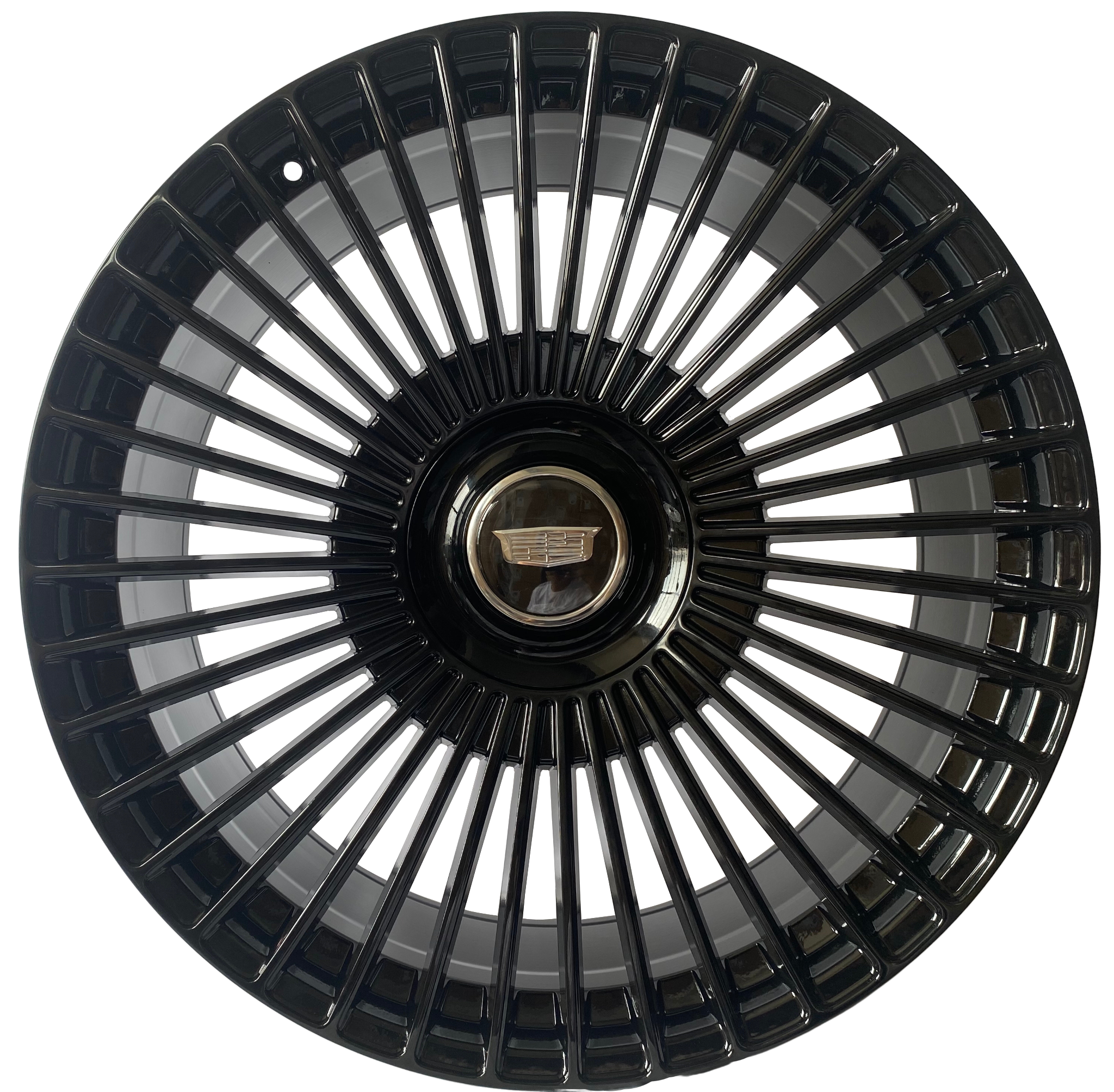


The wheel with the strongest brand recognition isn’t automatically the right fit for your vehicle. When comparing strasse wheels vs bespoke custom forged monoblock wheel options, a product gallery can help you judge the look, but it may not answer the questions that matter most: how the wheel is constructed, whether it fits your vehicle, and which details can be tailored.
Before choosing, compare like-for-like specifications. Forged, monoblock, and multi-piece describe different aspects of a wheel, so they shouldn’t be treated as interchangeable. Strasse’s documented options include different constructions, while a bespoke approach starts with a requested specification. The right route depends on your vehicle, desired stance, and design priorities.
This guide compares the details confirmed for a specific Strasse model with the questions to ask about a bespoke forged monoblock. It explains how to assess construction, customization, and fitment without assuming every model has the same specifications. ICON WHEELS offers custom-built forged wheels for select luxury vehicle applications. Ask whether a monoblock configuration can be confirmed for your exact vehicle, along with the proposed diameter, width, offset, and brake clearance.
Key Takeaways
- Use the strasse wheels vs bespoke custom forged monoblock wheel options comparison to weigh documented model details against the flexibility of a custom specification.
- Separate construction from marketing language: a monoblock is one piece, while a multi-piece wheel uses distinct components.
- Compare confirmed specifications and vehicle fitment. Don’t assume a bespoke wheel is automatically lighter, stronger, or more compatible.
- Before requesting a fitment review, prepare your vehicle details, intended use, preferred construction, and design priorities.
- If you’re considering a custom-forged option from ICON WHEELS, confirm whether a monoblock configuration is available for your exact vehicle.
Strasse Wheels vs. Bespoke Forged Monoblocks: What Is Actually Being Compared?
The first question is whether a documented wheel model meets your needs or whether you should explore a specification built around your vehicle. That makes strasse wheels vs bespoke custom forged monoblock wheel options a comparison of specific product details, not just two labels. Before weighing brand or appearance, compare the vehicle application, dimensions, construction, and finish.
The terms describe different things. Forging refers to a manufacturing method; monoblock describes a wheel constructed as one piece. A multi-piece wheel is assembled from separate components. Styling is a separate consideration: spoke shape, concavity, and lip design affect appearance, but don’t establish how the wheel was made or how it is constructed. For a general overview of forged or cast manufacturing, see Wikipedia’s alloy wheel reference.
What does bespoke custom forged monoblock mean?
“Bespoke” signals a specification-led order, not unlimited options or automatic compatibility. Your vehicle and preferences can guide the requested design, but the supplier still needs to confirm what can be made and whether it fits. Monoblock means one-piece construction. The term alone doesn’t establish a particular strength, weight, or performance outcome.
Keep three questions separate: how the wheel is made, whether it is one-piece or multi-piece, and how it looks. A forged wheel can use different construction formats, and a particular style doesn’t prove a particular manufacturing method. Compare each point using confirmed details.
What does the Strasse T5 page confirm?
The Strasse T5 Deep Concave page describes a three-piece forged reverse-lip wheel, so it isn’t a monoblock. The page lists 6061-T6 treated forged aluminum and customization language. Those details apply to the T5 page, not automatically to every Strasse model.
This distinction matters if a gallery image or model name is shaping your shortlist. Check the product page for the exact wheel you’re considering, then confirm its application for your vehicle. Don’t use T5 details as a substitute for another model’s specifications.
For a useful comparison, put equivalent information side by side: the same vehicle, wheel dimensions, construction type, and finish. If one option lacks confirmed details, list them as questions rather than assuming the options match. This keeps your decision grounded in fitment and your preferred look, not brand names alone.
How Construction, Fitment, and Design Change the Comparison
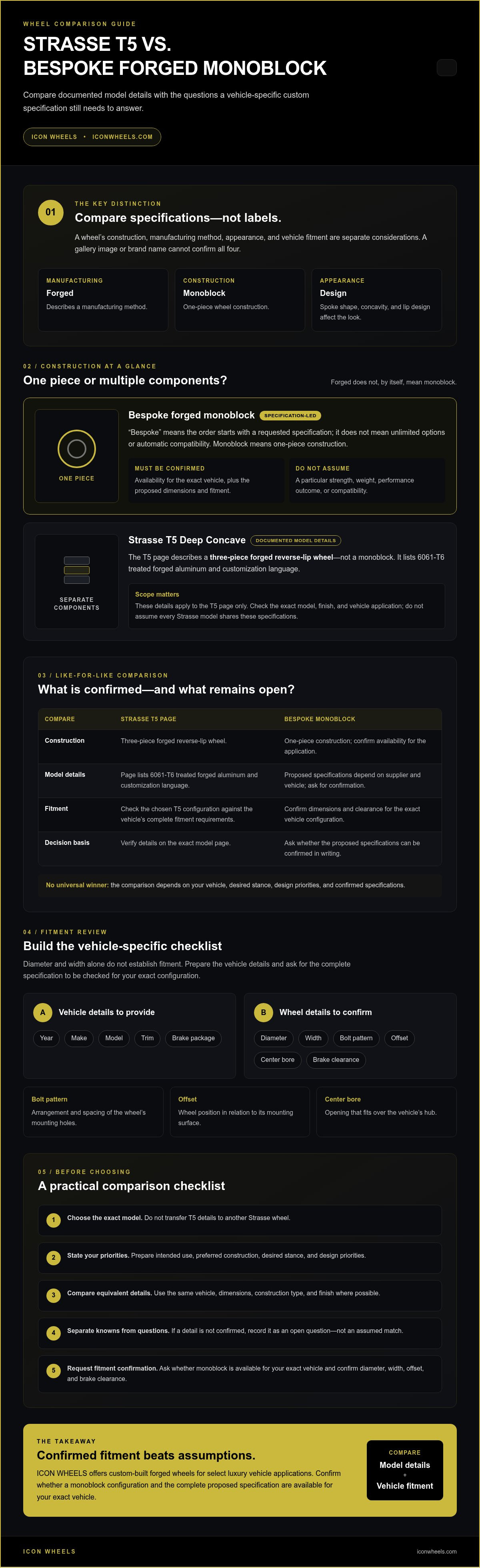
Compare a specific Strasse model with a proposed bespoke specification. The table distinguishes documented construction from details that still need checking. It doesn’t declare one format universally better.
| Construction | Confirmed model details | Fitment checks | Open questions |
|---|---|---|---|
| One-piece monoblock | One wheel piece; bespoke availability and specifications depend on the supplier and vehicle. | Confirm dimensions, bolt pattern, offset, center bore, and brake clearance for the exact vehicle. | Is this construction available for the application? Are the proposed specifications confirmed in writing? |
| Three-piece | The Strasse T5 Deep Concave page describes a three-piece forged reverse-lip wheel. | Check the chosen T5 configuration against the vehicle’s complete fitment requirements. | Do the listed details apply to this exact model, finish, and application? |
Which fitment details should buyers compare?
Start with your vehicle’s year, make, model, trim, and brake package. Diameter and width matter, but they don’t establish fitment or confirm clearance around the brakes. Bolt pattern is the arrangement and spacing of the wheel’s mounting holes. Offset describes the wheel’s position in relation to its mounting surface. Center bore is the opening that fits over the vehicle’s hub. Brake clearance is the space between the wheel and brake components.
Before ordering, ask the supplier to confirm the complete specification in writing for your exact vehicle configuration. Treat model-specific dimensions and compatibility statements as details to verify, not infer from a gallery image or a similar vehicle. For a reference point on aftermarket wheel testing, consult SAE J2530 aftermarket wheel standards. Don’t assume a product meets a standard unless that’s documented.
How do style and construction affect the final look?
Assess visual details separately. Spoke design shapes the face, concavity describes how the spokes curve inward, and lip profile changes the edge and depth effect. The T5 Deep Concave page’s deep-concave and reverse-lip descriptions apply to that model only. Finish is another choice; review the Custom Forged Wheel Finishes guide to consider how surface appearance supports the overall design.
For strasse wheels vs bespoke custom forged monoblock wheel options, compare a confirmed vehicle-specific specification with a documented model, then assess construction and appearance on their own merits. If you’re considering a tailored forged option, explore custom-built forged wheels and ask which configuration and fitment details can be confirmed for your vehicle.
Does a Bespoke Monoblock Offer More Than a Strasse Wheel?
Not by definition. “Bespoke” means the order is shaped around a requested specification; it doesn’t automatically mean the wheel will be lighter, stronger, more compatible, or better suited to your vehicle. Those judgments depend on evidence for the exact wheel and application. Compare documented specifications, design priorities, and confirmed fitment rather than relying on what a label implies.
The practical trade-off is often a defined product versus the possibility of tailoring. A documented model gives you a specific design and product information to assess. A specification-led custom request may be worth exploring if your requirements don’t align with an existing model, but you’ll need to establish which details can be tailored and which are fixed. For either route, ask what documentation supports claims about construction and testing. SAE International publishes SAE J2530 performance requirements for aftermarket wheels; confirm whether relevant documentation is available for the specific wheel you’re considering.
When might a documented Strasse model suit the brief?
A Strasse model may suit you if its confirmed construction and design match your priorities. Start with the product information for that exact model, not an image of a similar-looking wheel. Compare the listed details with your vehicle’s verified requirements, including its brake package and fitment. If a key specification is missing, ask for confirmation before treating the model as a match.
When should buyers investigate a bespoke monoblock?
Consider a custom inquiry if you have a particular design direction or need a vehicle-specific specification that a documented model doesn’t appear to address. Ask directly whether a monoblock configuration is available for your exact application. Don’t assume that requesting a bespoke forged wheel guarantees a one-piece build.
Define your request before comparing responses. Specify the vehicle and your visual priorities, then ask the supplier to identify:
- Which aspects can be customized, such as design or finish.
- Which dimensions and fitment details are confirmed for your vehicle.
- Which construction details are fixed and which still need confirmation.
This turns strasse wheels vs bespoke custom forged monoblock wheel options into a practical decision rather than a contest of assumptions. Choose a documented model when its verified details meet your brief. Explore a bespoke route when your priorities call for a different specification, and proceed only when construction and fitment are clear.
A Buyer’s Checklist for Comparing Strasse and Custom Forged Wheels
Use the same brief to assess a documented Strasse model and a custom-built option. That keeps the strasse wheels vs bespoke custom forged monoblock wheel options decision tied to your vehicle, priorities, and confirmed specifications rather than a visual impression alone.
- 1. Record your vehicle details. Note the year, make, model, trim, and brake configuration. Include your existing wheel specifications if you have them.
- 2. Define intended use. Describe how you expect to use the vehicle and what matters most in your choice. Keep the brief specific, but don’t assume a wheel is suitable until fitment is confirmed.
- 3. Set construction and visual priorities. State whether you prefer a one-piece monoblock or are open to another construction. Record design preferences such as spoke pattern, concavity, lip profile, and finish.
- 4. Request exact specifications. Ask which construction and specifications apply to the selected model. Request a complete specification sheet for the exact wheel and vehicle application, including bolt pattern, offset, center bore, and brake clearance.
- 5. Clarify what the order includes. Ask which finishes are available, what can and can’t be customized, whether any hardware is included, and what order terms apply. Get these details before deciding.
- 6. Get fitment confirmed in writing. Ask the supplier to match the final proposed wheel specification to your vehicle’s year, trim, and brake configuration. Keep the confirmation with the specification sheet.
Verify the final specification, not just the model name
A gallery image or a fitment example for a similar vehicle doesn’t confirm compatibility with your exact configuration. Review each detail in the proposed specification and ask the supplier to resolve missing or unclear information before proceeding. Mercedes owners researching applications can also consult The Definitive Guide to Wheels For Mercedes-Benz alongside vehicle-specific fitment confirmation.
With your vehicle details and priorities ready, explore custom-built forged wheels for luxury vehicles and ask whether the desired construction and fitment can be confirmed for your application.
Choose Your Wheel Partner: From Comparison to a Confirmed Specification
Choose a documented Strasse model when its confirmed construction, design, and fitment meet your requirements. If they don’t, investigate a custom specification. Either way, base your decision on details confirmed for your exact vehicle, not a similar-looking wheel or a general brand claim.
ICON WHEELS offers custom-built forged wheels for luxury vehicle applications, including Mercedes, Rolls-Royce, Land Rover, Porsche, Bentley, Cadillac, and Lamborghini. It’s an option to discuss if you’re seeking a tailored forged-wheel solution. This doesn’t confirm that a monoblock configuration is available for every vehicle, so ask about your specific application.
What information helps start a custom wheel inquiry?
Prepare a clear brief before reaching out. Include your vehicle’s year, make, model, trim, and brake information. Then describe the design you have in mind, including preferred construction, spoke style, concavity, and finish. Reference images can help explain your aesthetic priorities, but they don’t establish technical fitment.
Ask which dimensions and fitment details can be confirmed for your application. Request clarity on the proposed construction, including whether a monoblock is available, and have the final specification checked against your vehicle. Keep confirmed details separate from preferences that still need review.
How to take the next step with ICON WHEELS
Use the same approach for a custom inquiry as you would for a documented model: share your vehicle details, explain your design preferences, and ask which specifications can be verified. This keeps the conversation focused and surfaces unanswered questions before you commit. Rolls-Royce owners comparing factory-style and custom options can also read Rolls Royce OEM Wheels vs. Custom Forged as background for their decision.
For strasse wheels vs bespoke custom forged monoblock wheel options, look for a partner who can address your priorities with a clear, vehicle-specific specification. Share your vehicle details and design priorities with ICON WHEELS to ask which custom-forged options, including possible construction configurations, can be confirmed for your application.
Choose With Confidence, Then Confirm the Fit
The strongest choice in the strasse wheels vs bespoke custom forged monoblock wheel options comparison isn’t the one with the most appealing label. It’s the option whose construction, design, and specifications meet your priorities and are confirmed for your exact vehicle. A documented Strasse model may be right when its details align with your brief. If they don’t, a custom specification may be worth exploring, but bespoke doesn’t automatically mean better or guarantee monoblock availability.
Before ordering, confirm fitment against your vehicle’s year, make, model, trim, and brake configuration. ICON WHEELS offers custom-built forged wheels for luxury makes including Mercedes, Rolls-Royce, Land Rover, Porsche, Bentley, Cadillac, and Lamborghini. Ask which specifications and construction options can be confirmed for your application.
Discuss a custom forged wheel specification with ICON WHEELS using your vehicle details and design priorities. With the right questions and written fitment confirmation, you can move forward with clarity and choose a wheel that reflects your vision.
Frequently Asked Questions
Are Strasse wheels forged?
Some Strasse models are documented as forged, but verify the specifications for the exact wheel you’re considering. For example, the Strasse T5 Deep Concave product page describes a three-piece wheel made from 6061-T6 treated forged aluminum. That information applies to the T5, not automatically to every Strasse model. Check the individual product details for construction and materials, then confirm that the selected configuration suits your vehicle.
Is the Strasse T5 Deep Concave a monoblock wheel?
No. The Strasse T5 Deep Concave page describes a three-piece forged reverse-lip wheel, not a monoblock. Deep-concave styling doesn’t change the construction type. If you’re comparing it with a one-piece forged monoblock, assess the confirmed specifications of both options rather than relying on appearance or a gallery image. Verify the details for the exact model and application before deciding.
What is the difference between a monoblock and a three-piece wheel?
A monoblock is constructed as one wheel piece. A three-piece wheel is assembled from separate components. That distinction describes construction, not styling or manufacturing method: a wheel’s design and whether it is forged are separate details to check. Neither format is automatically right for every vehicle or buyer. Compare confirmed specifications, fitment, and appearance against your priorities.
Can bespoke forged monoblock wheels be made for any luxury car?
No. “Bespoke” doesn’t guarantee that every construction or specification is available for every vehicle. Availability depends on the supplier’s capabilities and the requirements of the specific application. ICON WHEELS offers custom-built forged wheels for makes including Mercedes, Rolls-Royce, Land Rover, Porsche, Bentley, Cadillac, and Lamborghini. Ask whether a monoblock configuration can be confirmed for your exact vehicle before treating it as an option.
How do I know whether custom forged wheels will fit my car?
Provide the supplier with your vehicle’s year, make, model, trim, and brake configuration. Ask them to confirm the proposed wheel’s dimensions, bolt pattern, offset, center bore, and brake clearance for that exact setup. Diameter and width alone don’t prove fitment. Request written confirmation of the final wheel specification before ordering, and clarify open details rather than assuming a similar vehicle or gallery example is an exact match.
Are bespoke custom wheels better than Strasse wheels?
Not automatically. Bespoke wheels offer a specification-led route, while a documented Strasse model may already match your design and fitment requirements. Neither label proves that a wheel is lighter, stronger, more compatible, or better suited to your needs. In the strasse wheels vs bespoke custom forged monoblock wheel options comparison, focus on confirmed construction, specifications, design priorities, and vehicle-specific fitment before choosing.
