


What if “Asanti” and “aerospace 6061-T6” aren’t competing wheel choices at all? The phrase asanti luxury wheels vs aerospace 6061 t6 custom forged rims puts a brand beside a material and manufacturing description, which makes a direct comparison difficult. Asanti offers wheels with 6061-T6 forged aluminum centers, so meaningful differences depend on the specific wheel’s construction and documented specifications.
It’s reasonable to want a distinctive design without guessing about strength, suitability, or fit. Brand prestige and terms like “aerospace grade” don’t answer every practical question. Check the wheel’s material and manufacturing method, the documentation for its specifications and testing, and whether its dimensions and load rating suit your vehicle.
This guide clarifies what each side of the comparison describes and shows how to assess construction, fitment, and customization using details you can verify. You’ll also find questions to ask before choosing custom forged wheels for a luxury vehicle, so your decision accounts for both your design preferences and your vehicle’s requirements.
Key Takeaways
- In the asanti luxury wheels vs aerospace 6061 t6 custom forged rims comparison, separate the brand name from the alloy and temper description before judging either option.
- Ask for model-specific documentation confirming the alloy, temper, construction method, and any relevant testing or certification details.
- Check fitment against your vehicle’s exact year, make, model, and trim, including brake-clearance requirements.
- Define how you’ll use the vehicle, then assess whether the wheel’s documented specifications suit those needs.
- Compare verified specifications and fitment details before choosing a design. Don’t rely on material or marketing labels alone.
Asanti Luxury Wheels vs. 6061-T6 Custom Forged Rims: What Is Actually Being Compared?
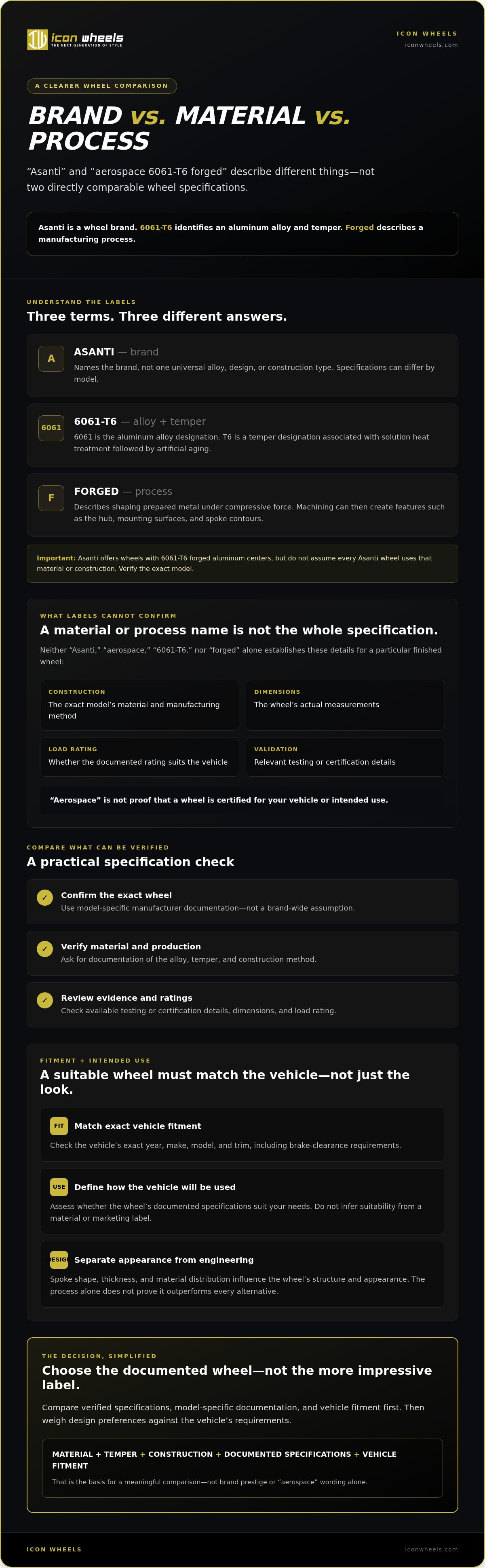
These labels describe different things. Asanti is a wheel brand. 6061-T6 identifies an aluminum alloy and its temper, while forged describes a manufacturing process. That means “asanti luxury wheels vs aerospace 6061 t6 custom forged rims” isn’t a like-for-like comparison. Neither phrase alone tells you a wheel’s complete construction, dimensions, load rating, testing, or suitability for a particular vehicle.
Asanti identifies the wheel brand; 6061-T6 identifies an aluminum alloy and temper, while “forged” describes how the wheel is formed.
A custom forged rim is formed through a forging process and specified or designed to meet particular requirements. Customization concerns the selected design and specifications; forging concerns how the metal is shaped. Material and process are related parts of a wheel’s description, but they aren’t interchangeable. Verify each detail for the exact wheel instead of treating a label as proof of performance.
What does Asanti luxury wheels mean in this comparison?
Asanti names the brand, not a single alloy, design, or construction type. A brand may offer wheels with different specifications across its range, so don’t assume every Asanti wheel is forged or uses 6061-T6 aluminum. Check the manufacturer’s documentation for the exact model, including its material and construction. Without that evidence, brand recognition alone can’t establish strength, weight, or suitability for your vehicle.
What does aerospace 6061-T6 custom forged rims mean?
“6061” is the aluminum alloy designation; “T6” is a temper designation indicating a particular condition achieved through heat treatment and artificial aging. The 6061-T6 aluminum alloy reference explains the alloy and temper in more detail. “Forged” makes a separate claim about how the wheel is formed, which should also be verified in product documentation.
“Aerospace” doesn’t certify a wheel for a specific vehicle or use. It may refer to an alloy’s applications or serve as marketing language, but it isn’t a substitute for evidence about the finished wheel. Look for documentation confirming the actual alloy and temper, construction method, fitment, and relevant testing. The complete specification, not the prestige of a phrase, is what lets you make a grounded comparison.
How 6061-T6 Aluminum and Forging Affect a Custom Wheel
A wheel’s material and manufacturing method answer separate questions. The alloy describes the metal’s composition; the temper describes its treated condition; forging describes how the material is formed. None of these alone determines how the finished wheel performs. That depends on the complete design and whether the wheel has been validated for its intended application.
What 6061-T6 tells a wheel buyer, and what it does not
6061 is an aluminum alloy designation. T6 identifies a temper generally associated with solution heat treatment followed by artificial aging. The label helps identify the material condition, but it doesn’t specify a wheel’s dimensions, spoke geometry, load rating, or test results. Check claims about aerospace use or suitability for a particular vehicle against reliable documentation instead of inferring them from the wording.
Aluminum’s potential role in reducing vehicle mass helps explain its use in automotive engineering. The U.S. Department of Energy outlines the importance of lightweight materials, but that general context doesn’t establish the weight or performance of any particular wheel. Those depend on the finished design and its specifications.
How forging and wheel design work together
Forging shapes prepared metal under compressive force to create a wheel blank or preform. The starting material and production steps can vary, so “forged” doesn’t prove that every wheel uses the same alloy or process. Machining then removes material from the formed piece to create features such as the hub, mounting surfaces, and spoke contours.
Design choices matter. Spoke shape, thickness, and material distribution influence the finished wheel’s structure and appearance. A carefully engineered forged wheel may meet specific weight and strength targets, but the process alone doesn’t prove it outperforms every cast or flow-formed alternative. Look for model-specific specifications and validation.
Alloy identifies the material, temper describes its condition, forging names a forming process, and finished-wheel performance depends on design and validation.
That distinction is central to asanti luxury wheels vs aerospace 6061 t6 custom forged rims: compare documented wheel details, not a material label against a brand. If you’re considering a vehicle-specific option, review custom-built forged wheels alongside the fitment and specifications your vehicle requires.
Asanti vs. 6061-T6 Forged Rims: Compare Specifications, Not Slogans
A useful comparison starts with two exact wheel models, not a brand name on one side and a material-and-process description on the other. The phrase asanti luxury wheels vs aerospace 6061 t6 custom forged rims doesn’t identify specific products, so it can’t support a reliable verdict about performance or fitment. Use manufacturer documentation to fill in the details before comparing.
| Specification | Asanti wheel | 6061-T6 custom forged rim |
|---|---|---|
| Brand | Asanti is the brand; identify the exact model. | The phrase does not identify a brand; confirm the maker. |
| Alloy | Requires documentation for the specific model. | 6061 is stated, but request documentation for the finished wheel. |
| Temper | Requires model-specific documentation. | T6 is stated; confirm it applies to the wheel’s material. |
| Construction | Verify the model’s manufacturing method. | “Forged” is claimed; confirm the process and wheel configuration. |
| Fitment | Check dimensions and vehicle application. | Check dimensions and vehicle application. |
| Documentation | Request specifications and applicable test records. | Request specifications and applicable test records. |
| Intended use | Confirm the maker’s stated application. | Confirm the maker’s stated application. |
Which engineering specifications deserve a direct comparison?
Compare equivalent wheel sizes and applications only when reliable specifications are available for both. Start with diameter and width, then confirm offset, bolt pattern, and center bore. Check vehicle-specific brake and suspension clearance as well. Ask for the documented load rating and applicable testing for the exact wheel configuration. If a specification is missing, mark it as unverified rather than assuming the wheels are comparable.
How should buyers interpret strength, weight, and durability claims?
Broad claims such as “stronger,” “lighter,” or “more durable” need comparable evidence tied to the exact models. A material label or forging claim alone can’t establish real-world suitability. Design, manufacturing quality, intended use, and validation all matter. Compare documented weights and ratings under equivalent conditions, and ask what testing supports each claim.
For a Rolls-Royce application, fitment and the intended balance of appearance and engineering deserve close attention. See this guide to Rolls-Royce OEM wheels versus custom forged wheels for a related comparison. The soundest verdict comes from a model-by-model review of documented specifications, not a brand-versus-material shorthand.
Choose Luxury Custom Forged Rims by Vehicle Fitment and Intended Use
A custom wheel should complement the vehicle without compromising fitment. Follow a clear sequence: identify the exact vehicle, confirm fitment, define how you’ll use it, then review the wheel’s documentation. This brings practical requirements into focus before design preferences or brand names steer the decision.
- Identify the vehicle: Record the exact year, make, model, and trim.
- Confirm fitment: Check the wheel dimensions and clearances against reliable vehicle and wheel specifications.
- Define intended use: Consider whether the vehicle is primarily driven on public roads or used in another specific way, and raise those requirements with a wheel specialist.
- Review documentation: Verify the specifications and applicable testing for the exact wheel configuration.
This checklist is more useful than relying on a broad vehicle-family label or assuming a familiar brand guarantees compatibility. It also gives you a consistent framework for evaluating the asanti luxury wheels vs aerospace 6061 t6 custom forged rims question for your vehicle.
What fitment details should be confirmed before ordering?
Ask for confirmation of diameter, width, offset, bolt pattern, and center bore. Check brake clearance for the specific vehicle, including its trim and brake setup. Verify any vehicle-specific load requirements against reliable vehicle and wheel documentation. A wheel that appears to match, or is described as suitable for a model family, may still need closer verification. Don’t treat appearance, brand, or a general compatibility claim as fitment approval.
Use intended road use to guide your questions. Explain how the vehicle will be driven and ask what documented load rating and application details support that use. Keep the discussion specific to the wheel model and configuration under consideration.
How should styling and finish fit the vehicle?
Consider how spoke design, concavity, finish, and overall proportions work with the vehicle’s character. A dramatic face may create a stronger visual statement, while a restrained design may better preserve an original, balanced appearance. For ideas on personalization, explore custom forged wheel finishes.
Keep the decision clear: aesthetic preference helps define the look, but it doesn’t establish engineering suitability or confirm fitment. Review those requirements separately. Once you’ve identified the vehicle and the specifications you need, explore ICON WHEELS custom forged wheels as an option for luxury vehicle applications.
Make the Final Call: Select a Documented Wheel, Not a Label
The comparison comes down to one clear distinction: Asanti is a brand, while 6061-T6 describes an aluminum alloy and temper. Neither label alone tells you whether a wheel is right for your vehicle. For asanti luxury wheels vs aerospace 6061 t6 custom forged rims, the stronger choice is the one whose exact specifications, fitment, and intended application are documented and meet your requirements.
A specific Asanti model may suit you if its verified construction, dimensions, and application align with your vehicle and priorities. For example, Asanti describes its AS 2-Piece Series as having 6061-T6 forged aluminum centers. Confirm that information for the exact model under consideration, then check its complete specifications and vehicle fitment. Don’t assume details for one model apply to the whole brand.
A practical decision checklist before you commit
Before selecting a wheel, request information for the precise model and configuration. Then compare it with your vehicle’s requirements, not with a broad marketing phrase.
- Ask for the exact model specification, material designation, construction details, and dimensions.
- Confirm fitment for your vehicle’s year, make, model, and trim, including brake clearance.
- Verify documented load requirements and relevant testing for the wheel configuration.
- Compare equivalent specifications from each manufacturer. Treat missing or unverified details as unanswered questions.
“Aerospace” wording and brand prestige may help describe positioning, but neither replaces wheel-specific documentation. A fair comparison needs equivalent information on both sides.
When custom forged wheels are the logical next step
Custom forged wheels merit consideration when vehicle-specific fitment and a distinctive design are priorities. ICON WHEELS specializes in custom-built forged wheels for luxury vehicle applications, with offerings for marques including Rolls-Royce, Mercedes, Porsche, and Bentley. Evaluate any option by its documented details and how they match your vehicle and intended use. Don’t infer a particular alloy, load rating, or fitment without confirmation.
Make the final choice with precision: confirm the application, compare the specifications, and choose the design that suits your vehicle without compromising its requirements. Explore custom forged wheel options from ICON WHEELS as you consider a vehicle-specific solution.
Choose Your Next Wheels With Confidence
The key to asanti luxury wheels vs aerospace 6061 t6 custom forged rims is recognizing that the terms describe different things: Asanti is a brand, while 6061-T6 identifies an alloy and temper. Neither label alone confirms a wheel’s complete construction or suitability. Compare exact models using documented specifications, and verify dimensions, fitment, clearance, and intended use for your vehicle.
Custom forged wheels can be worth considering when you want a distinctive design shaped around your vehicle’s requirements. ICON WHEELS specializes in custom-built forged wheels for luxury vehicles, with catalog applications for Mercedes, Rolls-Royce, Land Rover, Porsche, Bentley, Cadillac, and Lamborghini. Review the available options with your vehicle details and priorities in mind.
Explore custom forged wheels for your luxury vehicle and take the next step toward a considered choice. With the right questions and verified specifications, you can pursue a look that feels unmistakably yours while keeping fitment at the center of the decision.
Frequently Asked Questions
What is the difference between Asanti wheels and 6061-T6 forged rims?
Asanti is a wheel brand; 6061-T6 identifies an aluminum alloy and temper, so these aren’t equivalent categories. For the asanti luxury wheels vs aerospace 6061 t6 custom forged rims comparison, identify the exact wheel models and compare verified construction, dimensions, fitment, intended use, and supporting documentation. A brand name doesn’t establish one alloy or process, and a material label doesn’t specify a complete wheel. Avoid declaring either option better without comparable model-level evidence.
Are all Asanti wheels made from 6061-T6 aluminum?
Don’t assume every Asanti wheel uses 6061-T6 or the same manufacturing method. Specifications can differ by model, so check the manufacturer’s documentation for the exact wheel you’re considering. Look for explicit information about alloy, temper, and construction. If reliable model-specific documentation doesn’t confirm a detail, treat it as unverified rather than applying a claim about one wheel to the entire brand.
Is 6061-T6 aluminum automatically better for custom forged rims?
No, a material designation alone can’t prove that a finished wheel is the better choice. Design, dimensions, manufacturing quality, intended application, load rating, and validation all matter. Compare wheels intended for equivalent applications, and ask for documentation supporting performance claims. “Aerospace” wording doesn’t replace wheel-specific evidence or confirm suitability for your vehicle. Assess the complete specification instead of choosing by alloy label alone.
What does T6 mean in 6061-T6 aluminum?
T6 is a temper designation that describes the material’s processing condition. It complements 6061, the aluminum alloy designation, but doesn’t describe how a wheel is forged or machined. Nor does it tell you the finished wheel’s dimensions, design, load rating, or vehicle compatibility. For technical material details, consult an authoritative reference, then verify that the specific wheel’s documentation confirms its alloy and temper.
Are forged rims suitable for every luxury vehicle?
No, a forged rim isn’t automatically suitable for every luxury vehicle. Confirm diameter, width, offset, bolt pattern, center bore, and brake clearance for the exact year, make, model, and trim. Check applicable load requirements against reliable vehicle and wheel documentation as well. Don’t rely on appearance, brand, or a broad model-family claim as proof of compatibility. Confirm fitment with the wheel provider and seek qualified guidance before ordering or installation.
How can I compare custom forged rims with a branded wheel?
Start with exact product models, not a brand name on one side and a material phrase on the other. Compare documented alloy, temper, construction, dimensions, vehicle fitment, load rating, validation, and intended use. Keep confirmed specifications separate from marketing claims. If a key detail is missing, ask the manufacturer or wheel specialist for model-specific documentation before deciding. A like-for-like comparison makes strengths, limitations, and unanswered questions clearer.
Does aerospace-grade aluminum prove that a wheel is stronger?
No, aerospace wording alone doesn’t establish a finished wheel’s strength, performance, or suitability for a particular vehicle. Those depend on the specific material, wheel design, manufacturing quality, testing, and documented application requirements. Ask for traceable evidence tied to the exact wheel model and configuration. Compare equivalent products and test information where available. Treat broad material descriptions as a starting point for questions, not proof of a performance advantage.
