
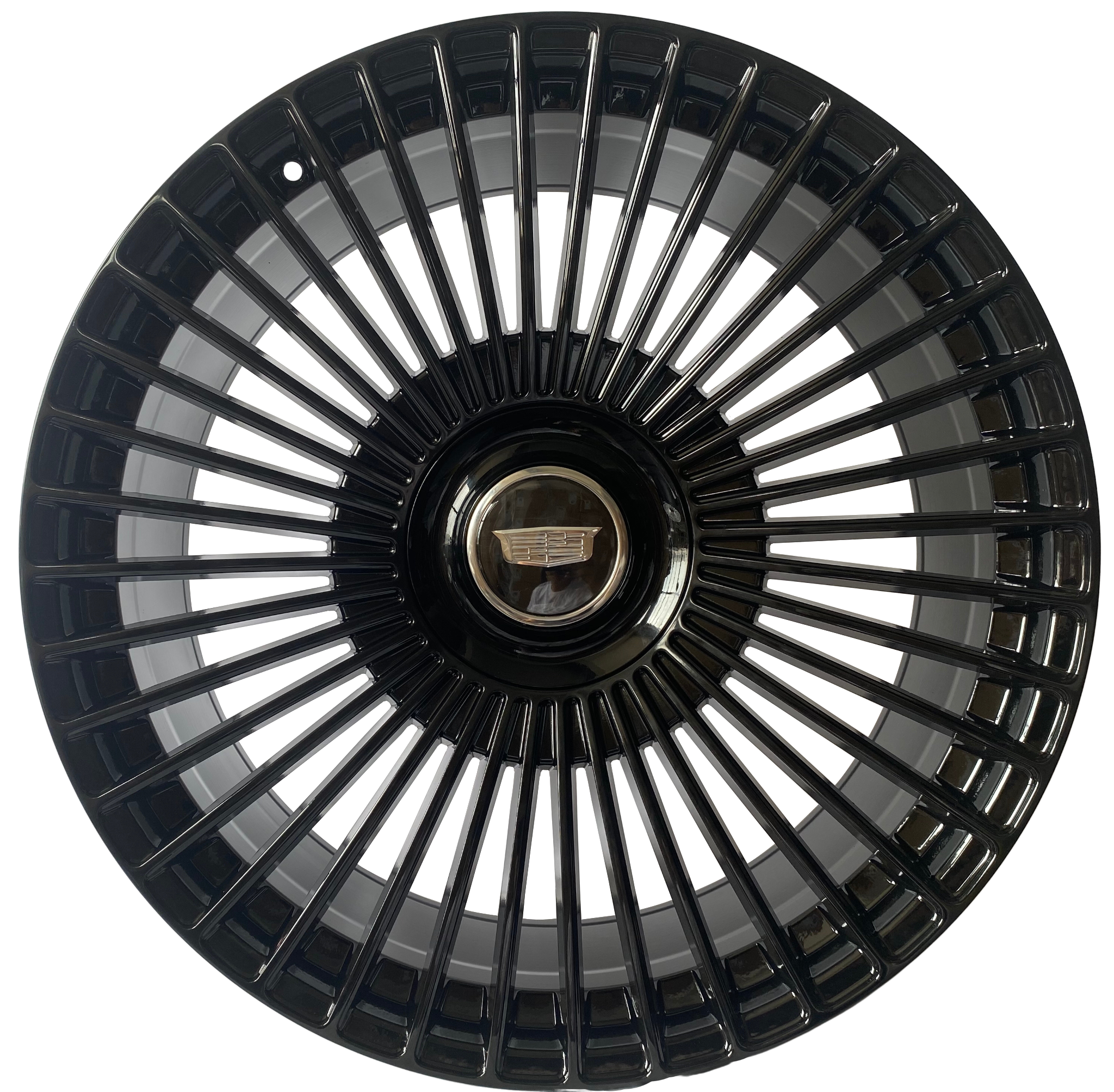
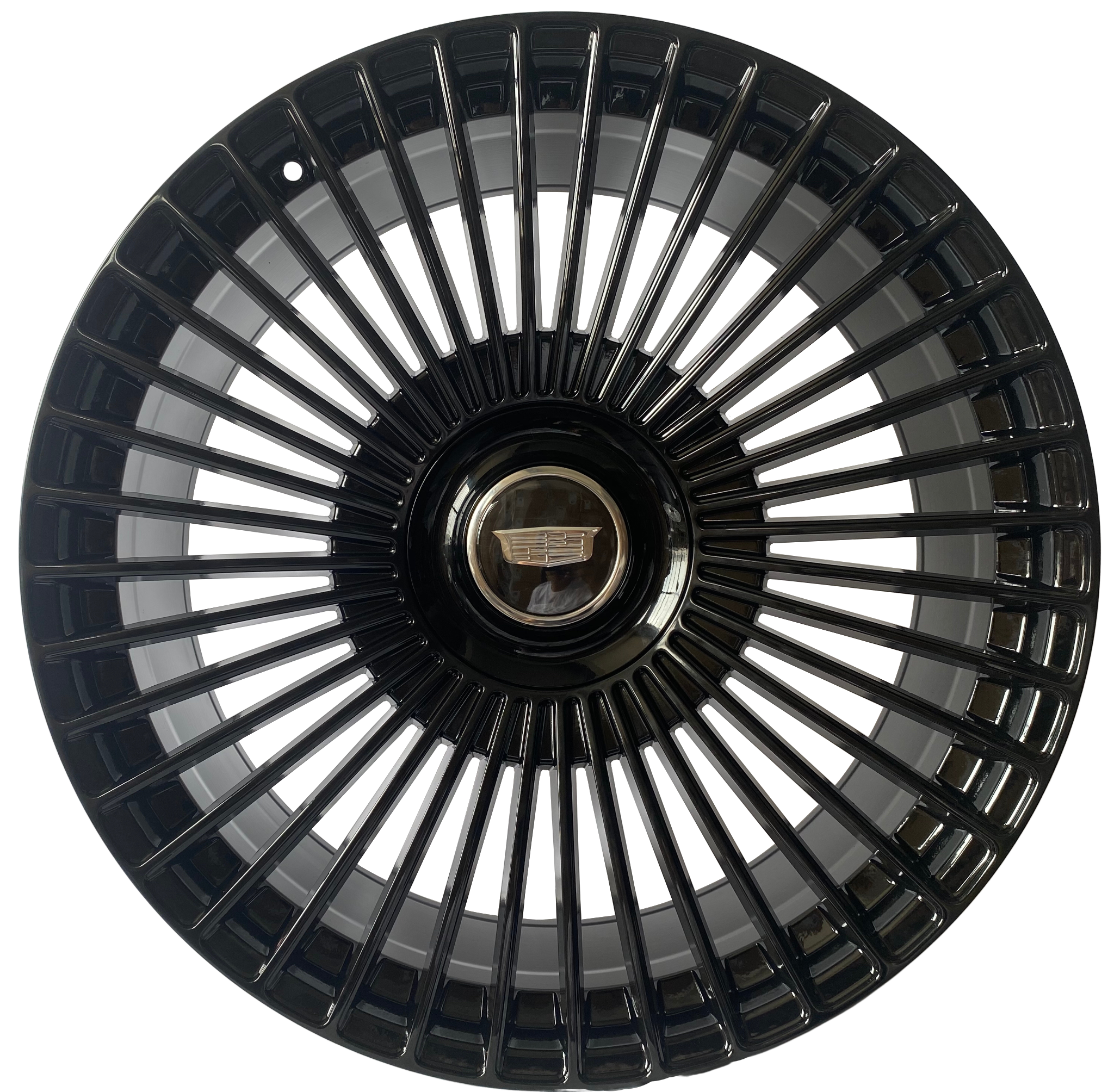


The aggressive profile of a deep concave wheel is the ultimate statement of automotive dominance. Most owners unknowingly sacrifice structural integrity for "look-alike" cast designs that simply can't handle the weight of a modern flagship. You know your vehicle deserves more than a generic solution. A high-performance SUV or an elite sedan demands concave forged wheels for luxury cars that are engineered, not just manufactured. You shouldn't have to choose between a head-turning stance and the smooth, vibration-free ride your car was built to provide.
This 2026 guide empowers you to master the technical and aesthetic nuances required to transform your vehicle's presence. We'll show you how to achieve a bespoke, deep-dish look that maintains OEM comfort while significantly reducing unsprung weight for better handling. You'll discover why 6061-T6 aluminum is the standard for clearing massive performance brakes and supporting heavy chassis. It's time to move beyond the confusion of the aftermarket and secure a wheel setup that's specifically load-rated for your vehicle's exact requirements.
Key Takeaways
- Understand why 6061-T6 aerospace-grade aluminum is the non-negotiable standard for maintaining structural integrity in deep concave designs.
- Learn to distinguish between monoblock rigidity for peak performance and multi-piece architectures for maximum aesthetic customization of lip depth.
- Master the technical relationship between wheel offset and profile depth to ensure your concave forged wheels for luxury cars clear massive performance brake calipers.
- Discover the necessity of vehicle-specific engineering to guarantee that high-load luxury SUVs maintain OEM comfort and safety at high speeds.
Defining the Concave Profile: Why Luxury Aesthetics Demand Depth
The concave profile isn't just a design choice; it's a structural masterpiece. In its simplest form, a concave wheel features a face that curves aggressively inward from the outer rim toward the center hub. This creates a sense of depth that flat-face wheels simply cannot replicate. For owners of elite vehicles, this geometry is essential. It provides a wider, more commanding stance that visually anchors the car to the road. Concave forged wheels for luxury cars represent the intersection of aerospace engineering and high-end styling. They offer an aggressive aesthetic without compromising the structural integrity required for heavy luxury chassis. True luxury concavity is about more than just a deep center. It's about the precision of the curve and how it interacts with light and shadow to highlight the vehicle's lines.
The Evolution of the Concave Design
The industry has moved far beyond the flat-face classic rims of the past. By 2026, the trend has shifted toward extreme depth and sculptured geometry. Modern CAD software allows engineers to push the limits of inward curvature while maintaining perfect balance. While cast "look-alikes" attempt to mimic this depth, they often lack the strength to handle the stress of such aggressive angles. High-strength 6061-T6 forged aluminum has become the mandatory choice for those who demand both form and safety. Forging allows for thinner spokes with higher load ratings, making the most extreme designs possible. It's the difference between a wheel that looks the part and one that performs at 150 mph.
Concavity Levels: Flat vs. Mid vs. Deep
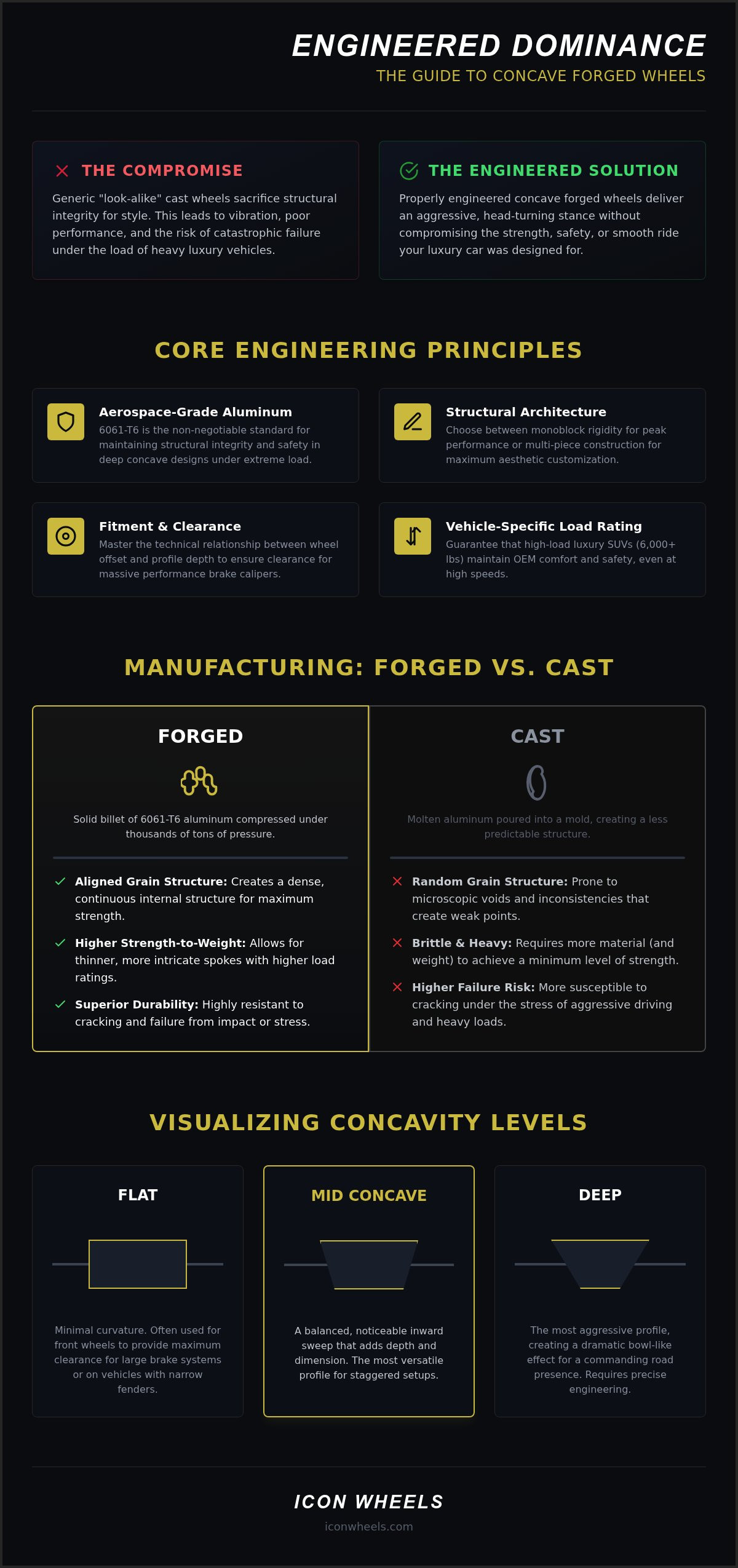
Not all concavity is created equal. "Deep Concave" is the pinnacle of the luxury market, reserved for vehicles with the axle clearance to support it. Understanding these levels is vital for a perfect fitment.
- Flat Profile: Minimal curvature, often used for front wheels on cars with limited brake clearance or narrow fenders.
- Mid Concave: A balanced inward sweep that adds dimension without requiring extreme offsets.
- Deep Concave: The most aggressive profile, creating a dramatic bowl-like effect at the center.
The Engineering Behind Deep Concave Forged Aluminum Wheels
Engineering a deep concave profile is an exercise in managing extreme physics. When selecting concave forged wheels for luxury cars, the material is the first line of defense. We use 6061-T6 aerospace-grade aluminum because it offers the highest strength-to-weight ratio available in the industry. This material is essential for maintaining structural integrity when the wheel face is aggressively recessed. Deep concavity creates a lever effect on the center hub; every inch of inward sweep increases the stress at the point where the spokes meet the barrel. Forged aluminum handles this leveraged stress without the risk of cracking, a common failure point in inferior cast alternatives.
The secret lies in the grain structure. Forging compresses a solid billet of aluminum under thousands of tons of pressure, aligning the metallic grain with the actual shape of the wheel. This creates a continuous, dense internal structure that is significantly stronger than cast metal. Cast wheels are made by pouring molten aluminum into a mold, which often results in microscopic voids and a brittle composition. By using a denser material, we can machine thinner, more intricate spokes that carry higher load ratings than bulkier cast designs. This engineering allows for the dramatic visual depth that defines modern luxury styling.
Load Ratings for Heavy Luxury SUVs
High-performance SUVs like the Rolls Royce Cullinan or Cadillac Escalade present a unique engineering challenge. These vehicles weigh over 6,000 pounds and capable of high speeds, meaning the wheels must endure massive vertical and lateral loads. Generic concave wheels often fail here because they prioritize looks over load-bearing capacity. To calculate the load rating for a 24-inch forged rim, engineers divide the vehicle's maximum gross axle weight rating by two and incorporate a safety multiplier to account for dynamic impact forces. This ensures that even under hard cornering or sudden impacts, the wheel center remains perfectly true. You can explore our Custom Built Forged Wheels to see how we balance these extreme load requirements with elite aesthetics.
Unsprung Weight and Handling Dynamics
Reducing unsprung weight is the most effective way to sharpen the performance of a heavy luxury sedan or SUV. Forged wheels are typically 20 to 30 percent lighter than cast wheels of the same size. This reduction in rotational mass allows the suspension to react with greater precision. In vehicles equipped with sophisticated air suspension, such as Land Rover models, lighter wheels reduce the workload on the dampers and air bags. This results in faster acceleration, shorter braking distances, and a more composed ride over uneven surfaces. You gain the aggressive stance of a deep concave profile while actually improving the factory handling characteristics.
Monoblock vs. Multi-Piece: Selecting the Right Architecture
Choosing the right architecture for your vehicle is a decision between raw performance and aesthetic versatility. Both monoblock and multi-piece constructions offer distinct advantages for concave forged wheels for luxury cars. The decision depends on whether you prioritize the absolute lowest rotational mass or the ability to fine-tune every millimeter of your car's stance. While both utilize aerospace-grade aluminum, the way they are assembled changes how they interact with your vehicle's chassis and suspension. Understanding these differences is the key to achieving a setup that looks as good as it performs.
The Case for Monoblock Concavity
Monoblock forged wheels are machined from a single solid billet of aluminum. This architecture is the pinnacle of lightweight performance and structural rigidity. It's the preferred choice for high-speed performance cars like a Porsche 911 or a Lamborghini Huracán. Because there are no bolts or seams, the wheel is incredibly stiff, providing direct feedback through the steering wheel. The seamless aesthetic of a single-piece block creates a clean, modern look that highlights the flow of the spokes. To understand why this manufacturing process is superior to traditional methods, read The Science of Forged Wheels: Why They Outperform Cast. For daily-driven luxury sedans, the monoblock design offers a "set it and forget it" reliability with virtually no maintenance beyond regular cleaning.
Multi-Piece Customization and Deep Lips
Two-piece and three-piece wheels consist of a forged center face bolted to one or two barrels. This modularity allows for maximum customization of lip depth and offset. If you want to combine a concave face with a massive outer rim, the "Deep Dish" look, multi-piece is the only way to go. This architecture is ideal for wide-body builds where standard offsets simply won't fill the wheel wells. One significant advantage is repairability; if you curb a wheel, you can replace a single barrel rather than the entire unit.
However, multi-piece wheels require more attention. The hardware must be checked periodically to ensure everything remains torqued to spec. There are also unique technical challenges when sealing three-piece concave wheels for high-torque EVs. The massive instant torque from an electric motor can put immense stress on the sealant and bolts. For these applications, we often recommend a two-piece "duoblock" which offers the look of a multi-piece wheel with the structural integrity of a monoblock. Whether you choose the purity of a monoblock or the bespoke nature of a multi-piece build, the goal remains a perfect, aggressive stance.
Fitment Precision: Matching Concavity to Luxury Chassis
Achieving the perfect stance is a game of millimeters. For concave forged wheels for luxury cars, fitment precision is the difference between an automotive masterpiece and a mechanical failure. A true "flush" fitment aligns the wheel edge perfectly with the fender line of your Mercedes S-Class or Range Rover. This creates a seamless, authoritative look that suggests the car was born with this profile. If the offset (ET) is too high, the wheel looks sunken and weak, losing its visual impact. Conversely, an incorrect low offset leads to "poke" or tire rubbing, which is unacceptable for a vehicle designed for high-speed comfort and refinement. For those currently shopping for an elite SUV or sedan to personalize, you can find out more about Pre-owned Vehicle Sales and Financing to find the perfect luxury platform.
Measuring for Maximum Depth
Every luxury chassis has a physical limit for concavity. We calculate the maximum allowable depth by measuring the distance from the hub mounting surface to the fender edge while accounting for full suspension compression. Hub-centric design is non-negotiable for the elite driver. It ensures the wheel is centered perfectly on the vehicle's hub, eliminating the high-speed vibrations that often plague generic aftermarket setups. For SUV owners looking to push the limits of their vehicle's geometry, read The Definitive Guide to 22 Inch Range Rover Wheels: Forged Performance and Style to see how we maximize depth for the latest Range Rover platforms.
Brake Clearance and Spoke Profile
High-performance models from Porsche and Lamborghini feature massive rotors and multi-piston calipers that demand respect. This requires significant "X-factor" clearance, which is the space between the back of the wheel spokes and the brake hardware. We use precision 3D laser scanning to map the entire brake assembly before a single cut is made in the aluminum billet. This data allows us to sculpt the back of the spokes to clear carbon-ceramic rotors with sub-millimeter accuracy, even on the most aggressive concave profiles. The deeper the concavity, the less clearance remains for high-performance brake calipers, requiring a delicate balance of spoke curvature and offset. We don't rely on luck; we rely on aerospace-grade data. If you are ready to redefine your vehicle's presence, explore our Custom Built Forged Wheels for a bespoke fitment that clears every performance component while maintaining absolute structural dominance.
ICON WHEELS: Custom-Engineered Mastery for Elite Vehicles
ICON WHEELS is more than a manufacturer. We are curators of automotive excellence. Our concave forged wheels for luxury cars represent the peak of structural science and aesthetic ambition. Every set is a bespoke creation, engineered specifically for the weight, torque, and chassis dynamics of elite vehicles like the Rolls Royce Cullinan or the Bentley Bentayga. We don't believe in universal fitments. We believe in absolute perfection. Our design philosophy treats the wheel as a functional sculpture, where every curve is calculated to enhance the vehicle's natural lines while providing the strength required for a three-ton luxury chassis. This commitment to engineering ensures that your vehicle maintains its status as a leader on the road.
Rolls Royce Floating Center Cap Integration
Maintaining the iconic floating center cap is a non-negotiable requirement for the elite owner. Integrating this feature into a deep concave face requires advanced machining precision. The center bore must be engineered to house the weighted mechanism while allowing the spokes to sweep inward with maximum aggression. This technical mastery is why ICON is the preferred choice for Rolls Royce Wraith and Ghost owners who refuse to compromise on brand heritage. We ensure the logo remains perfectly upright, even as the concave spokes create a dramatic sense of depth that factory wheels cannot match. For a deeper look at how our engineering stacks up against factory options, read Rolls Royce OEM Wheels vs. Custom Forged: The Elite Engineering Guide.
Custom Forged Solutions for Mercedes and Land Rover
Our expertise extends to the flagship sedans and heavy-duty SUVs that define the modern luxury landscape. For the Mercedes S-Class, we design tailored offsets that achieve a flush, commanding stance without the need for spacers or modifications. Land Rover and Range Rover owners benefit from forged durability that handles the immense weight of these vehicles while delivering a street presence that commands respect. We offer custom finishes that complement specific factory paint codes and interior textures, from brushed titanium to satin champagne. Every wheel is specifically load-rated to ensure safety under the most demanding conditions. Our commitment to load-rated safety means you never have to worry about structural failure, even on the heaviest luxury SUVs. Explore our custom forged wheel collections at ICON WHEELS to find the ultimate upgrade for your vehicle. We provide the expertise you need to transform your car into a singular expression of your status and style.
Elevate Your Vehicle’s Presence with Engineered Precision
Your Rolls Royce, Mercedes, or Range Rover deserves concave forged wheels for luxury cars that are specifically load-rated for its unique chassis. High-performance brake clearance and vibration-free driving are the hallmarks of a professional setup. Don't settle for less than a custom-engineered masterpiece that reflects your status. Design your bespoke concave forged wheels at ICON WHEELS and experience the peak of automotive art. Your journey toward a transformed vehicle starts with a single, decisive choice.
Frequently Asked Questions
Do concave wheels affect the ride quality of my luxury car?
Ride quality remains unchanged or improves when you switch to high-performance forged aluminum. Because forged wheels are 20% to 30% lighter than cast alternatives, they reduce unsprung weight, allowing your air suspension to react faster to road imperfections. This engineering ensures you maintain OEM comfort while gaining a more aggressive stance. If you choose correctly load-rated wheels, you won't experience the vibrations often associated with generic aftermarket rims.
Can I install deep concave wheels on a heavy SUV like a Rolls Royce Cullinan?
Yes, deep concave profiles are perfectly suited for the Rolls Royce Cullinan provided they are custom-engineered for its 6,000-pound curb weight. We specialize in creating high-load rated concave forged wheels for luxury cars that handle the extreme vertical and lateral forces of elite SUVs. Every wheel center is reinforced to manage the leveraged stress of the deep inward sweep, ensuring structural dominance and safety at high speeds.
What is the difference between forged concave wheels and cast concave wheels?
The primary difference is the internal grain structure and structural density. Forged wheels are machined from a solid 6061-T6 aluminum billet under extreme pressure, making them significantly stronger and lighter. Cast wheels are made by pouring molten metal into a mold, which creates a more brittle structure prone to cracking under the stress of deep concavity. Forging allows for thinner, more elegant spokes that carry much higher load ratings for heavy vehicles.
Will deep concave wheels clear my cars performance brakes?
Bespoke engineering ensures that even the most aggressive concave profiles clear massive OEM carbon-ceramic or Brembo rotors. We use 3D laser scanning to map your vehicle's specific brake calipers, allowing us to sculpt the back of the spokes with sub-millimeter precision. This X-factor clearance is critical for Porsche and Lamborghini models. We balance the inward sweep of the spokes with the necessary room for your high-performance stopping hardware.
Are monoblock or multi-piece concave wheels better for daily driving?
Monoblock wheels are generally better for daily driving due to their simplicity and extreme structural rigidity. They require zero maintenance beyond regular cleaning and offer a set it and forget it reliability. Multi-piece wheels offer more customization but require periodic hardware checks to ensure the bolts remain torqued to factory specifications. For most luxury sedan owners, the monoblock architecture provides the perfect blend of performance, durability, and a clean, seamless aesthetic.
How do I choose the right offset for a concave look without rubbing?
Choosing the right offset requires a precise calculation of your vehicle's fender clearance and suspension travel. A flush fitment aligns the wheel edge with the fender, while an incorrect offset leads to tire rubbing or an unsightly poke. We utilize vehicle-specific data to determine the exact millimeter of offset needed to maximize concavity without interfering with the wheel wells. This precision engineering ensures a commanding stance that maintains full steering lock.
Can I keep my Rolls Royce floating center caps with ICON concave wheels?
Our engineering team specifically designs wheel centers to integrate the Rolls Royce floating center cap mechanism. This allows the iconic logo to remain upright and stationary while the vehicle is in motion. We machine a custom bore within the concave face to house the weighted OEM component perfectly. This integration is a hallmark of our commitment to brand heritage, ensuring your Wraith, Ghost, or Cullinan retains its factory prestige.
What maintenance is required for custom forged concave rims?
Maintaining custom forged rims requires regular cleaning with pH-neutral soaps to protect specialized finishes. Avoid automated car washes that use harsh acidic chemicals or abrasive brushes. We recommend:
- Hand washing with microfiber mitts.
- Applying ceramic coatings to repel brake dust.
- Inspecting multi-piece hardware during tire rotations.
