


The lowest monthly payment can be the most expensive way to upgrade your vehicle. This luxury forged wheel financing guide helps you look beyond the payment and compare what you’ll actually commit to, from total repayment and fees to when ownership begins.
It’s reasonable to want a manageable payment when choosing a custom wheel specification for a luxury vehicle. But lease-to-own and installment financing work differently: one may involve renting with an option to buy, while the other is structured as a loan to purchase. Before comparing agreements, identify your vehicle’s fitment requirements and the forged wheel specification you want. Then review each offer against the same criteria. You’ll learn how to assess payment structures, spot charges that can raise the total, and weigh flexibility against ownership priorities. The result is a clearer plan for selecting custom-built forged wheels that suit both your vehicle and your budget.
Key Takeaways
- Use this luxury forged wheel financing guide to compare agreements by total commitment, not monthly payment alone.
- Check how lease-to-own and installment financing define payment schedules, ownership, and end-of-term options.
- Compare the amount financed, scheduled payments, disclosed fees, and total repayment side by side.
- Start with your exact vehicle model and year, then narrow the wheel specification around fitment and intended use.
- Review the agreement before committing, and align its ownership terms with your priorities and budget.
Luxury forged wheel financing: understand the commitment before you upgrade
A payment that fits your monthly budget doesn’t automatically make the full purchase affordable. Financing lets you pay over time instead of paying the entire purchase amount upfront, but the agreement sets the repayment schedule, costs, and ownership terms. Those details shape the real commitment.
This matters when you’re considering custom fitment and a particular wheel design. Choose a specification for the exact vehicle, not by payment amount alone. The vehicle model and year, fitment requirements, and intended use help define what you’re purchasing. ICON WHEELS offers custom-built forged wheels for luxury vehicles, so treat the specification as part of the decision: establish what suits your vehicle and priorities, then assess the financial terms attached to the purchase.
For background on how forged construction differs from other alloy wheel manufacturing methods, consult this overview of forged alloy wheels. Understanding the product helps you compare like with like, rather than judging an agreement before you know what wheel specification it covers.
What does financing a luxury forged wheel purchase mean?
Financing is an arrangement that spreads payment over time. Instead of paying the full amount at purchase, you make payments under written terms. Depending on the agreement, you may be borrowing to buy or entering a different arrangement with its own conditions. The contract defines your rights and obligations, including when ownership begins and what happens if payments are missed or the term ends. Review those provisions alongside the payment schedule, not as fine print to revisit later.
Why the monthly payment is only one part of the decision
A longer repayment term can lower each scheduled payment while extending how long you owe. Interest and disclosed fees can also increase the total repaid. Compare the full amount due over the agreement, not just the figure shown per month. Consider whether the complete commitment leaves room in your budget for other priorities, even if the monthly amount appears comfortable.
The monthly payment measures pace; the total financial commitment measures the full cost of the decision.
Before accepting terms, write down the amount being financed, payment frequency, number of payments, interest, fees, and any conditions that affect ownership. Then compare that commitment with your planned wheel specification. Custom fitment and design choices shape what you’re purchasing, so decide what you want before an attractive payment steers you toward a different configuration. The goal is a specification that suits the vehicle and a repayment commitment you understand from the outset.
Lease-to-own and installment financing for forged wheels: know the difference
Two offers can show similar scheduled payments yet create very different obligations. One may be a credit agreement to purchase the wheels; another may be a lease with an option to buy. Similar payments don’t mean similar agreements: ownership, fees, and the final amount due depend on the contract.
Compare each offer using the same details, then read the written terms to understand what those figures mean. The Consumer Financial Protection Bureau’s guide to understanding auto loan financing explains key considerations for shopping for loans and reviewing terms. Its auto-loan guidance is useful context for credit agreements, while lease-to-own terms need to be assessed under their own contract.
How lease-to-own arrangements may differ from installment agreements
A lease-to-own arrangement generally sets payments for use of an item and defines conditions for buying it or reaching another outcome at the end of the term. Installment financing generally schedules repayment under a credit agreement for a purchase. Neither label tells the whole story: the specific contract governs rights, obligations, ownership timing, and what happens at the end.
Comparison point
Lease-to-own: Payments follow the lease terms; the agreement may provide an option to buy or other end-of-term choices. Check when ownership transfers and what a buyout requires.
Installment financing: Payments repay credit under the loan terms; ownership timing is defined by that agreement. Review the payment schedule and any conditions attached to the purchase.
Fees: For either structure, identify every disclosed fee and whether it is included in scheduled payments or due separately.
Early payoff: Check whether early purchase or repayment is permitted, how the amount is calculated, and whether charges or conditions apply.
Which agreement details deserve careful comparison?
Build a side-by-side record of the APR, payment frequency, term, disclosed fees, and total scheduled repayment, where stated. Then compare ownership timing, end-of-term choices, and early-payoff provisions. If a fee is separate from the scheduled payments, include it in your own total. If a term is unclear, resolve its meaning before signing rather than relying on a verbal summary.
Keep the agreement tied to the same vehicle-specific wheel specification in every comparison. That makes it easier to see whether different payments reflect different terms or a different purchase. The luxury forged wheel financing guide approach is straightforward: compare the contract, not just the headline payment, and consider whether the ownership terms and total commitment fit your priorities. Once you understand the agreement, explore custom-built forged wheels suited to your vehicle.
Compare luxury wheel financing by total repayment, fees, and ownership
A fair comparison starts with consistent inputs. Use the same wheel purchase amount and specification for each offer, then record the agreement details in one place. Don’t compare one offer’s monthly payment with another’s total repayment. The luxury forged wheel financing guide approach is to separate what you’re financing, what you’ll pay, and what the agreement says you’ll own.
Calculate the full commitment, not just the advertised payment
Use the figures stated in each agreement. Multiply scheduled payments by their number, then add disclosed fees that are payable separately. Record the amount financed apart from the total repayment so you can see how the agreement accounts for the purchase. If a figure or charge isn’t explained, don’t estimate it or treat it as zero. Resolve what it means before comparing offers.
| Comparison detail | Offer A | Offer B |
|---|---|---|
| Amount financed | Enter the contract amount | Enter the contract amount |
| Scheduled payments | Record amount, frequency, and number | Record amount, frequency, and number |
| Disclosed fees | List each fee and when it is due | List each fee and when it is due |
| Total scheduled repayment | Enter the stated total; add separate fees | Enter the stated total; add separate fees |
| Ownership and early payoff | Note timing, conditions, and terms | Note timing, conditions, and terms |
Separate wheel selection from package assumptions
Searches for “lease-to-own wheel and tire packages” can bring together different products and services. Treat that phrase as a search context, not proof that one agreement covers the same items as another. Read the itemized purchase description and identify exactly which products or services the contract includes. Keep the comparison focused on the specification you intend to purchase.
Fitment and design choices also determine whether two offers cover equivalent wheels. Match the vehicle, wheel specification, and selected finish before comparing payment terms. Exploring custom forged wheel finishes can help clarify the look you want to compare.
Ownership timing matters if you prioritize owning the wheels outright, while early-payoff terms matter if you may want to clear the commitment sooner. Read how the agreement handles both, including any conditions or charges, rather than assuming an option is available. Once your comparison reflects the same specification and full written terms, explore custom forged wheel options for your vehicle.
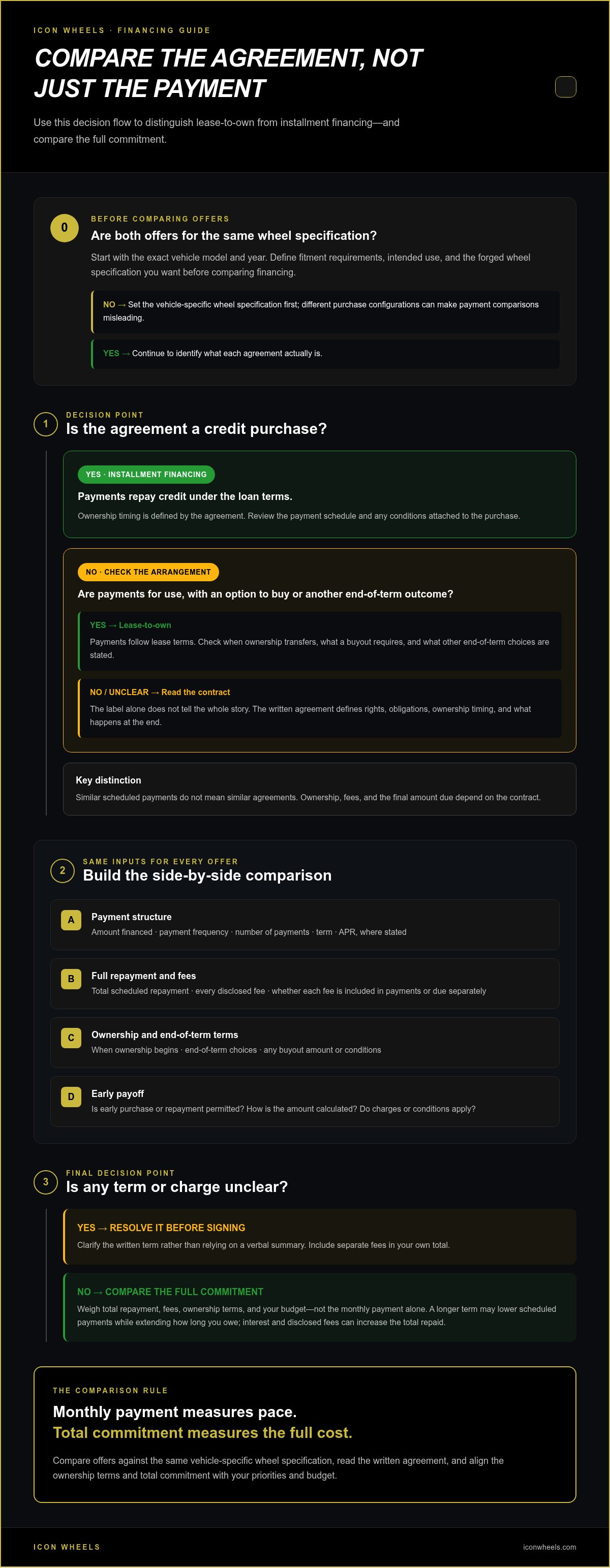
Use this checklist to prepare a luxury forged wheel purchase
Build the purchase from the vehicle outward. Confirm what fits, define the wheel specification, and set your financial limits once you know what you’re comparing. This sequence helps keep a compelling monthly payment from steering you toward the wrong wheel or an unclear agreement. Use the luxury forged wheel financing guide approach: establish the product first, then assess the commitment.
Confirm the vehicle and wheel specification first
Start with the exact vehicle, not a general brand category. Model year and configuration can affect fitment, so record them carefully. Existing wheel information can provide useful context, but it shouldn’t replace confirming a specification suited to the vehicle. For a model-specific example, the Mercedes-Benz forged wheel guide shows why precision matters. A Rolls-Royce OEM and custom forged wheel comparison offers another useful perspective on choosing a vehicle-specific direction.
- Identify the vehicle. Write down the make, exact model, and model year. Include relevant configuration details and, if available, information about the current wheels. This gives you a clear starting point for evaluating fitment rather than relying on a broad vehicle label.
- Define intended use. Consider how you use the vehicle and what you want the wheel upgrade to achieve. Your priorities may include a particular appearance or a specification suited to your driving needs. Let those priorities guide selection before considering payment options.
- Establish fitment requirements. Gather the wheel details that are available, such as diameter, width, offset, and bolt pattern. Treat these as information to verify for your specific vehicle, not universal recommendations. Fitment comes before styling preferences or financing comparisons.
- Choose a consistent specification. Record the forged wheel design and finish you’re considering. If you compare financial scenarios for different specifications, keep each one clearly identified. Otherwise, a change in the item being purchased can make payment offers look more comparable than they are.
- Set your spending limit. Base it on the full commitment you can manage, not simply a monthly amount. Leave room in your budget for other priorities, and decide your limit before reviewing offers so the terms don’t define affordability for you.
- Review each agreement. Note the repayment schedule, disclosed fees, ownership provisions, and any early-payoff conditions. Match the contract to the same wheel specification each time. If the agreement’s description doesn’t clearly reflect the intended purchase, resolve that discrepancy before making a commitment.
Build a purchase-readiness checklist
Before comparing offers, bring together your vehicle details, fitment information, chosen specification, and spending limit. Then record each agreement’s payment frequency, term, fees, total repayment, and ownership terms. This makes it easier to spot differences in both the financial structure and the purchase itself. Keep your notes together, and don’t treat an unclear term as settled.
With the vehicle and specification defined, you can make a considered choice among custom-built forged wheel options. Explore custom forged wheels for your vehicle as the next step in shaping an upgrade around fitment, style, and your priorities.
Move from financing research to a custom forged wheel decision
With the agreement details in view, bring the purchase back to the vehicle. Confirm fitment first, choose the wheel specification, compare agreements for that same choice, then commit only when both the product and full financial obligation are clear. This sequence keeps financing research grounded in what you actually intend to buy.
Match a custom forged wheel choice to the vehicle
A custom wheel decision should reflect the exact vehicle, not just its badge. Model-specific fitment and the selected specification belong at the center of the process, alongside your visual preferences and intended use. ICON WHEELS offers custom-built forged wheels for luxury vehicles including Mercedes, Rolls-Royce, Land Rover, Porsche, Bentley, Cadillac, and Lamborghini. Model-specific options include wheels for the Rolls-Royce Cullinan, Ghost, and Wraith, the Range Rover, and the Mercedes S-Class.
Use the vehicle details to narrow your choice, then keep that specification consistent as you assess the agreement. A different size, design, or finish may represent a different purchase, so avoid comparing payment scenarios as if they cover the same wheels when they don’t. Follow a clear sequence: vehicle, fitment, specification, then financial terms.
Make the next step deliberate and straightforward
Before accepting any financing terms, review the written agreement as carefully as the wheel selection. Confirm the purchase description, amount financed, scheduled payments, term, disclosed fees, and total repayment. Check when ownership begins, what choices apply at the end of the agreement, and whether early payoff is addressed. Make sure the terms you’re evaluating match the wheels you’ve selected.
Use this final review to bring the decision into focus:
- Confirm the vehicle: Match the make, model, and year to the intended fitment.
- Lock in the specification: Identify the forged wheel design and finish you want to purchase.
- Compare the same purchase: Evaluate payment structures against that consistent specification, not a changing set of options.
- Understand the commitment: Read the repayment, fees, ownership provisions, and early-payoff terms before agreeing.
A thoughtful luxury forged wheel financing guide decision connects the vehicle, wheel, and agreement into one clear plan. Make the fitment precise and the terms understandable, then choose with confidence.
Explore custom forged wheels from ICON WHEELS and move forward with a specification selected for your vehicle and priorities.
Choose a wheel upgrade that feels right long after purchase
The strongest purchase decision is one you can stand behind beyond the first impression. Let your vehicle, the wheel specification you want, and your ownership priorities lead the choice. Financing should support that decision, not define it. A clear view of the full commitment gives you room to choose with intention and avoid trading a specification you want for a payment that only looks appealing upfront.
Use this luxury forged wheel financing guide as a foundation for moving from research to a considered upgrade. ICON WHEELS offers custom-built forged wheel options for luxury vehicles across leading marques. Explore the possibilities, refine the direction that suits your vehicle, and make the next step your own.
Explore custom forged wheel options from ICON WHEELS. Choose with clarity and make your upgrade a confident expression of your vehicle and priorities.
Frequently Asked Questions
Is lease-to-own the same as financing forged wheels?
No. Installment financing is generally a credit agreement for a purchase, while lease-to-own usually begins as a lease with an option to buy under stated conditions. The distinction affects more than the payment schedule. For example, check whether missing a payment changes your right to continue toward ownership, and whether ending the agreement early has specific consequences. The contract, not the label in an advertisement, defines the arrangement.
Can luxury forged wheels be purchased through lease-to-own?
Whether lease-to-own applies depends on the specific agreement and whether it covers the custom wheel purchase. Examine how the terms handle changes, cancellations, or an order that hasn’t been completed. Don’t assume every agreement treats custom orders the same way. The written terms determine the available purchase option and what you must do to exercise it.
How do I compare wheel financing options fairly?
Use the same wheel specification and purchase description for every comparison, then put each offer’s APR, payment dates, term, separate charges, and stated repayment total side by side. This luxury forged wheel financing guide is most useful when the offers cover equivalent purchases. Note whether any amount is due upfront or at the end, and clarify whether listed fees are already included in the quoted total. That prevents mismatched assumptions from distorting your comparison.
Does financing custom forged wheels affect ownership?
It can, depending on the agreement. An installment purchase and a lease-to-own arrangement may set different ownership timing and conditions. That distinction matters if you plan to sell the vehicle, change wheel specifications, or otherwise dispose of the wheels before the term ends. Read the contract for restrictions, remaining payment obligations, and what happens after a transfer or change. Don’t assume owning or using the vehicle automatically settles the wheel agreement.
Can I pay off a wheel financing agreement early?
That depends on the written terms. Look for an early-payoff provision and how the payoff amount is calculated; it may not simply equal the remaining scheduled payments. Before making an extra payment, get the current payoff figure and understand how it affects the account balance and any charges under the agreement. For lease-to-own, distinguish early purchase terms from ordinary installment-loan payoff terms. They may lead to different amounts and ownership outcomes.
Should I choose the lowest monthly payment for luxury wheels?
Not automatically. A lower payment may come with a longer term, different ownership timing, or a larger total commitment. Consider whether the payment fits your budget while also checking the agreement’s end date and full repayment amount. If you might sell the vehicle before the agreement ends, review what happens to the remaining obligation. A payment is only one part of affordability; choose terms you can manage throughout their full duration.
What information should I have before comparing forged wheel financing?
Gather the vehicle’s make, exact model, model year, and available details from its current wheels, such as markings or dimensions. Note your intended use and the wheel specification you’re considering, including design and finish. You’ll also need each agreement’s complete payment schedule and written ownership conditions to make a useful comparison. Keeping the same vehicle and specification details with every offer helps ensure you’re evaluating the same purchase, not different configurations.
