


Choosing the right wheel size starts with your vehicle’s approved fitment, not appearance alone. To learn how to choose the right wheel size for my car, check the tire-size information on the driver’s-side door placard, in the owner’s manual, or on the tire sidewall. In a size such as P215/60 R17, R17 means the tire fits a 17-inch wheel.
A larger wheel can give your car a sharper, more distinctive stance, but the full fitment must still suit the vehicle. Diameter is only one factor: tire size and profile, wheel width and offset, bolt pattern, and load capacity all affect fit.
This guide explains tire-size markings and compares factory, optional, and aftermarket setups. You’ll learn which specifications determine whether a wheel clears the brakes, fenders, and suspension, and why each one matters for a suitable fit. Use these details to compare your current setup with a replacement or a custom look.
Key Takeaways
- Find your vehicle’s reference tire size on the driver’s-side door placard, in the owner’s manual, or on the tire sidewall.
- Read each part of a tire-size code to understand its width, profile, construction, and matching wheel diameter.
- Compare factory, optional, and aftermarket setups by considering the complete tire diameter, not wheel diameter alone.
- Assess wheel width and offset to help avoid contact with brakes, fenders, and suspension components.
- Confirm the bolt pattern matches exactly and that the wheels’ combined load capacity meets your vehicle’s rating.
Vehicle-specific factory wheel and tire fitment
If you’re wondering how to choose the right wheel size for my car, start with the factory fitment for your exact vehicle and trim. It gives you a reliable reference for comparing replacement wheels and tires.
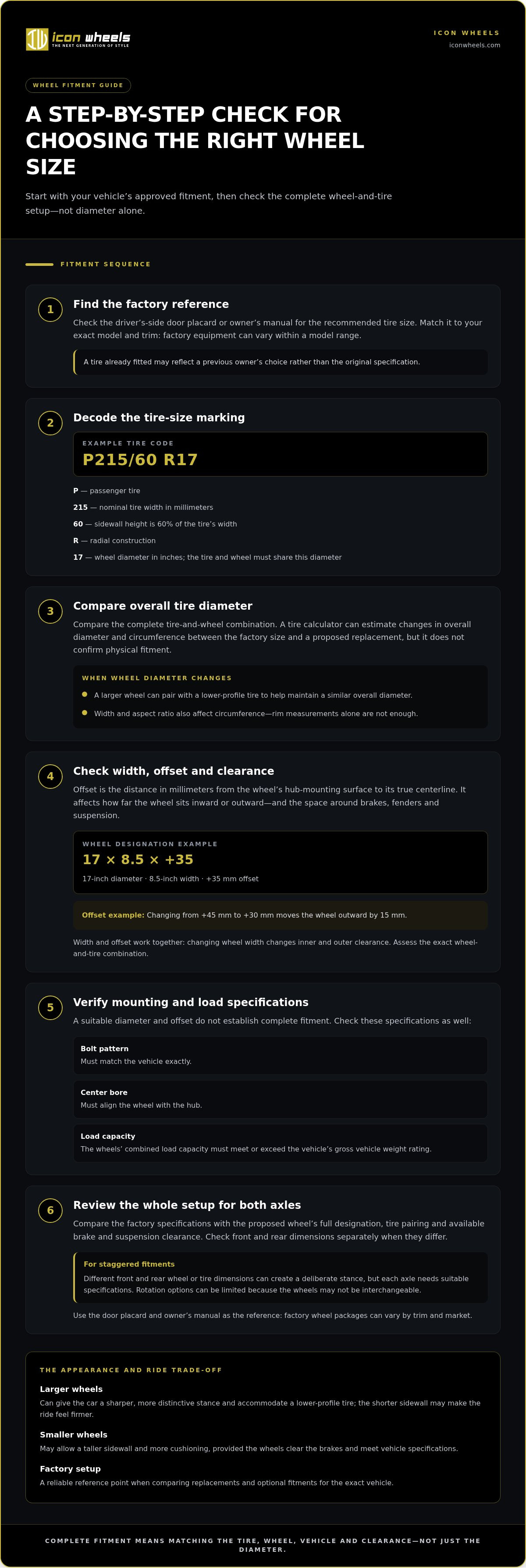
Find the recommended tire size on the driver’s-side door placard, in the owner’s manual, or on the tire sidewall. Compare the information with your vehicle’s exact model and trim, since factory equipment can differ within a model range. The placard and manual provide a vehicle-specific starting point. A tire already fitted may reflect a previous owner’s choice rather than the original specification.
Read the markings as a complete code. In P215/60 R17, P identifies a passenger tire, 215 is the nominal width in millimeters, and 60 means the sidewall height is 60% of the width. R indicates radial construction, while 17 is the wheel diameter in inches. The tire and wheel must share that diameter to fit together.
Larger wheels can sharpen your car’s appearance and accommodate a lower-profile tire, though the shorter sidewall may make the ride feel firmer. Smaller wheels may allow a taller sidewall and more cushioning, provided they clear the brakes and meet the vehicle’s specifications. Choose the balance that best suits your priorities: appearance, ride comfort, or retaining the factory setup.
Replacement costs in the United States depend on wheel construction and dimensions, tire choice, and the vehicle’s fitment requirements. Compare the complete wheel-and-tire setup rather than judging cost by wheel diameter alone. Decide on the specifications first so you can compare options on a like-for-like basis.
Comparing Setups with a Tire Calculator
A tire calculator compares one tire-size code with another and estimates changes in overall diameter and circumference. Enter the factory size and proposed replacement, such as P215/60 R17, to compare their measurements. This helps you evaluate a different wheel diameter paired with another tire profile. It gives you a useful dimensional comparison, while physical fitment still depends on the vehicle.
Matching Replacement Tire Diameter
To keep the replacement tire’s overall diameter close to the factory setup, compare the full tire-and-wheel combination. When wheel diameter increases, a lower-profile tire can help maintain a similar overall diameter. Width, aspect ratio, and other tire specifications also affect circumference, so don’t compare rim measurements alone. This is an important part of learning how to choose the right wheel size for my car.
For a US-market vehicle, use its door placard and owner’s manual as your reference. Factory wheel packages can vary by trim and market, so a fitment listed for another version may not suit your car. Match the tire-size information to the exact model before considering optional or aftermarket choices. The clearest starting point for how to choose the right wheel size for my car is the original fitment.
Aftermarket and optional wheel fitments
Optional and aftermarket wheels offer more choice, but diameter alone doesn’t establish fitment. Assess offset, bolt pattern, center bore, load rating, and any different front and rear dimensions as a complete setup.
Offset and Clearance
Offset is the distance in millimeters from the wheel’s hub-mounting surface to its true centerline. It determines how far the wheel sits inward or outward, affecting clearance around brakes, fenders, and suspension components. For example, changing from +45 mm to +30 mm offset moves the wheel outward by 15 mm. A 17 × 8.5 × +35 wheel designation describes a 17-inch diameter, 8.5-inch width, and +35 mm offset. Compare all three measurements with the vehicle’s existing fitment.
Key Fitment Specifications
Bolt pattern, center bore, and load rating help determine whether a wheel mounts correctly and can support the vehicle. The bolt pattern must match exactly, and the center bore must align the wheel with the hub. The wheels’ combined load capacity must meet or exceed the vehicle’s gross vehicle weight rating. These checks remain essential even when diameter and offset appear suitable.
A 7-inch-wide wheel with a positive 40 mm offset illustrates why width and offset work together. Offset is measured from the mounting face, not from the wheel’s outer edge. As wheel width changes, the inner and outer clearances change too. That can bring the tire closer to a suspension part or make it extend farther toward the fender. Assess the exact wheel and tire combination, since tire width also affects available clearance.
A staggered fitment uses different wheel or tire dimensions on the front and rear axles. It can create a deliberate stance and accommodate vehicle-specific handling goals, but each axle needs suitable specifications. Confirm that front and rear tire diameters suit the vehicle, and assess widths and offsets for clearance. Because the wheels may not be interchangeable, rotation options can also be limited.
Before choosing an optional setup, compare the factory specifications with the proposed wheel’s full designation. For a 17 × 8.5 × +35 wheel, assess diameter, width, and offset together, then match bolt pattern, center bore, and load capacity. Check the tire pairing and the space behind the wheel for brake and suspension clearance. A matching bolt pattern by itself doesn’t establish complete fitment.
For Mercedes owners considering a distinctive setup, precision fitment matters just as much as appearance. ICON WHEELS offers custom-built forged wheels for Mercedes. The right choice still depends on matching the wheel specifications, including offset and load rating, to the vehicle.
Bolt pattern and bolt circle diameter
A wheel’s bolt pattern describes the number of lug holes and the diameter of the circle they form. Read both details together: the hole count identifies the layout, while the bolt-circle diameter identifies the spacing. A wheel can have the correct diameter and still fail to match this mounting specification. Treat bolt pattern as a precise fitment requirement, not a visual detail.
In a 4-100 bolt pattern, four lug holes sit around a circle with a 100-millimeter diameter. In 5x100 mm, five bolts are evenly spaced around a 100 mm bolt circle. The first number describes the lug count; the second describes the circle’s diameter. These patterns aren’t interchangeable, even though both examples use a 100-millimeter circle.
Common bolt circle diameters include 100 mm, 112 mm, and 114.3 mm. That last measurement is not the same as 112 mm, despite the difference appearing small. A wheel’s bolt pattern must match the vehicle’s pattern exactly. A mismatch can prevent the mounting points from aligning correctly, so matching only the lug count isn’t enough.
Use the vehicle’s owner’s manual to identify its specified bolt pattern. If you can’t find the measurement there, the research guidance recommends contacting a local dealership. Record the complete notation, including both the lug count and circle diameter. For example, “five lug” alone doesn’t tell you whether the circle is 100 mm, 112 mm, or 114.3 mm.
- 4-100: Four lug holes arranged around a 100-millimeter circle.
- 5x100 mm: Five evenly spaced bolts around a 100 mm circle.
- 100 mm, 112 mm, or 114.3 mm: Common bolt circle diameter measurements.
Keep the notation consistent when comparing a vehicle and a replacement wheel. A 5x100 mm wheel isn’t a match for a vehicle specified with a five-lug pattern and a 112 mm circle. Likewise, a 4-100 pattern doesn’t match a five-lug design merely because both use a 100 mm circle. Count and diameter are separate parts of the specification.
Check the complete bolt pattern before comparing appearance or other dimensions. Diameter, width, and offset describe different aspects of fitment; none changes the bolt circle. Record the vehicle’s full pattern and compare it directly with the wheel specifications. This helps you rule out wheels with the wrong lug count or spacing.
Bolt pattern and lug-hole spacing
The lug holes must align with the vehicle’s mounting points, and the bolt pattern must match exactly. Count the holes and identify their spacing as separate details. A wheel with the right number of holes can still have the wrong pattern if the holes sit on a different bolt circle.
Common wheel patterns have 4, 5, 6, or 8 lug holes. The lug count describes how many fasteners secure the wheel. The bolt circle describes the circular path through the centers of those holes. Together, these details identify the pattern. They are distinct from wheel diameter, which describes the rim size, not the mounting layout.
Start with your vehicle’s owner’s manual to find its specified bolt pattern. If the manual doesn’t provide it, contact a local dealership. Record the complete specification, not just a phrase such as “five lug.” That count alone doesn’t describe the spacing, so it cannot establish whether a replacement wheel will align with the vehicle.
Compare the vehicle’s specification with the wheel’s listed pattern before considering appearance. Check both the hole count and bolt-circle measurement. If either differs, the mounting points won’t match. Don’t assume a wheel will fit because it has the same number of lug holes or looks similar to the original.
Bolt pattern is distinct from other fitment measurements. Wheel diameter identifies the rim size, while bolt pattern describes the lug-hole layout. Center bore is the opening at the wheel’s center, and offset is the position of the hub-mounting surface relative to the wheel centerline. Each measurement answers a different fitment question, so matching one doesn’t replace the others.
Use this comparison to keep the details distinct:
- Lug count: Count the wheel’s mounting holes, such as 4, 5, 6, or 8.
- Bolt circle: Match the specified spacing of those holes to the vehicle.
- Wheel diameter: Compare the rim size separately from the mounting pattern.
- Center opening: Treat the center bore as a separate dimension from lug spacing.
For a replacement wheel, verify the vehicle’s documented bolt pattern, then compare it directly with the wheel specification. Keep the full notation, including both the lug count and spacing. A matching hole count isn’t enough. An exact pattern match is essential, but it doesn’t establish complete compatibility: diameter, center bore, offset, and load capacity must also suit the vehicle.
Checking wheel compatibility with your vehicle
Wheel compatibility involves more than matching diameter. Compare tire size, wheel dimensions, mounting pattern, clearance, and load capacity with the vehicle as a whole. A wheel that matches one measurement can still conflict with another, so assess every specification before choosing a complete setup.
Incorrect sizing or fitment can prevent proper mounting or cause the tire or wheel to rub against brakes, fenders, or suspension components. Insufficient load capacity can also leave the vehicle’s wheel set below its gross vehicle weight rating.
Start with the vehicle’s factory specifications, then compare the replacement setup across these points:
- Tire and wheel diameter: The tire’s inner diameter must match the wheel diameter for mounting.
- Bolt pattern: The wheel’s lug count and bolt circle must match the vehicle exactly.
- Width and offset: These dimensions affect the wheel’s position and available clearance.
- Center bore: Compare the wheel’s center opening with the vehicle’s hub dimensions.
- Load capacity: The combined capacity of the vehicle’s wheels must meet or exceed its gross vehicle weight rating.
Clearance needs attention beyond a stationary visual comparison. Offset affects the wheel’s position relative to the hub, while wheel and tire width affect how much space the setup occupies. Check the space toward the brake assembly, suspension, and fender. The Honda CRX example shows why the wheel well matters: its test setup was limited to tires about 23 inches tall. That figure applies to the described CRX, not every vehicle.
When changing wheel diameter, compare the complete tire diameter with the factory setup. A lower-profile tire can help keep overall diameter close to the original with a larger wheel. Width, aspect ratio, and other tire specifications also affect circumference. Because a size change alters how the tire occupies the wheel well, diameter alone can’t establish compatibility.
Use a vehicle-specific checklist rather than treating one matching measurement as approval. Record the factory tire and wheel specifications, then compare each proposed dimension. Confirm the exact bolt pattern, hub fit, clearance, and adequate load capacity. A calculator can help compare tire dimensions, but it can’t show whether the wheel clears the brakes or suspension. For automotive enthusiasts or shop owners organizing fitment specs and project costs, dashboard templates from Biz Infographs offer a practical way to track complex technical data.
The practical rule is to assess every interface between the vehicle, wheel, and tire. A setup that clears the body but has the wrong bolt pattern isn’t compatible. A wheel that mounts correctly but lacks sufficient load capacity isn’t a complete fitment either. Base your decision on the full specifications, not appearance or diameter alone.
ICON WHEELS: Wheels For Mercedes
ICON WHEELS offers custom-built forged wheels for Mercedes owners considering a model-specific change. If you’re comparing factory fitment with an aftermarket setup, use this guide to define your priorities: diameter, width, offset, bolt pattern, center bore, and load capacity. Each specification matters to fit as much as appearance.
For a tailored direction, explore ICON WHEELS’ Custom Built Forged Wheels. The offering is suited to drivers seeking a custom-built option for their vehicle, with fitment considerations guiding the choice. Keep your Mercedes model and preferred setup in mind as you explore the available options.
Contact ICON WHEELS or visit iconwheels.com to explore Wheels For Mercedes.
Make Your Next Fitment Choice With Confidence
Knowing how to choose the right wheel size for my car is more useful when you turn that information into a clear design direction. Decide what you want your new wheels to express, then match that preference to the vehicle’s fitment requirements. A considered choice can shape your car’s character without compromising compatibility. Just as discerning vehicle enthusiasts curate their personal spaces with fine furnishings and crystalware from benjaminmaxwell.net, selecting the right wheels reflects a broader appreciation for craftsmanship and design.
ICON WHEELS offers custom-built forged wheels for Mercedes, Rolls-Royce, and Land Rover. Explore the option for your vehicle and the look you have in mind, then share your fitment goals with ICON WHEELS to take the next step.
Ask ICON WHEELS about fitment, and move forward with a wheel choice that feels distinctly yours.
Frequently Asked Questions
What do tire sizes mean?
A tire-size code describes its width, sidewall proportion, construction, and wheel diameter. For example, 225/70R14 indicates a nominal width of 225 mm, a sidewall aspect ratio of 70, radial construction, and a 14-inch wheel diameter. The numbers describe different dimensions, so don’t read the code as one measurement. The final number identifies the wheel diameter the tire is designed to fit.
How do I find my car's factory-recommended wheel and tire size?
Start with the driver’s-side door placard or owner’s manual, then match the information to your exact model and trim. If the fitted tires show a different size, compare that marking with the factory reference rather than assuming it’s original. Some vehicles use different front and rear sizes, so record each axle’s specification separately before comparing replacement setups.
Can I use a different wheel diameter while keeping the overall tire diameter the same?
Yes. A larger-diameter wheel can be paired with a lower-profile tire to keep overall tire diameter close to the original. As wheel diameter increases, sidewall height can decrease to compensate. Compare the full tire dimensions with a tire calculator, then assess width and clearance separately. A similar overall diameter alone doesn’t establish complete compatibility.
How can I check wheel and tire clearance from brakes, suspension, and fenders?
Compare the proposed wheel’s width and offset with the space around the brakes, suspension, and fenders. A visual check while the vehicle is stationary can miss contact when the steering turns or suspension moves. Assess the exact wheel-and-tire combination and its position relative to the hub. Clearance in one area doesn’t prove the setup clears every component.
What tools or online fitment guides can verify compatible wheel sizes?
A tire calculator can compare tire dimensions and estimate how a new size differs from the original. Use it alongside the vehicle’s factory specifications and the wheel’s complete measurements, including diameter, width, offset, bolt pattern, and center bore. Online tools help organize the comparison, but a calculation alone can’t establish physical clearance around the brakes, suspension, or fenders.
