
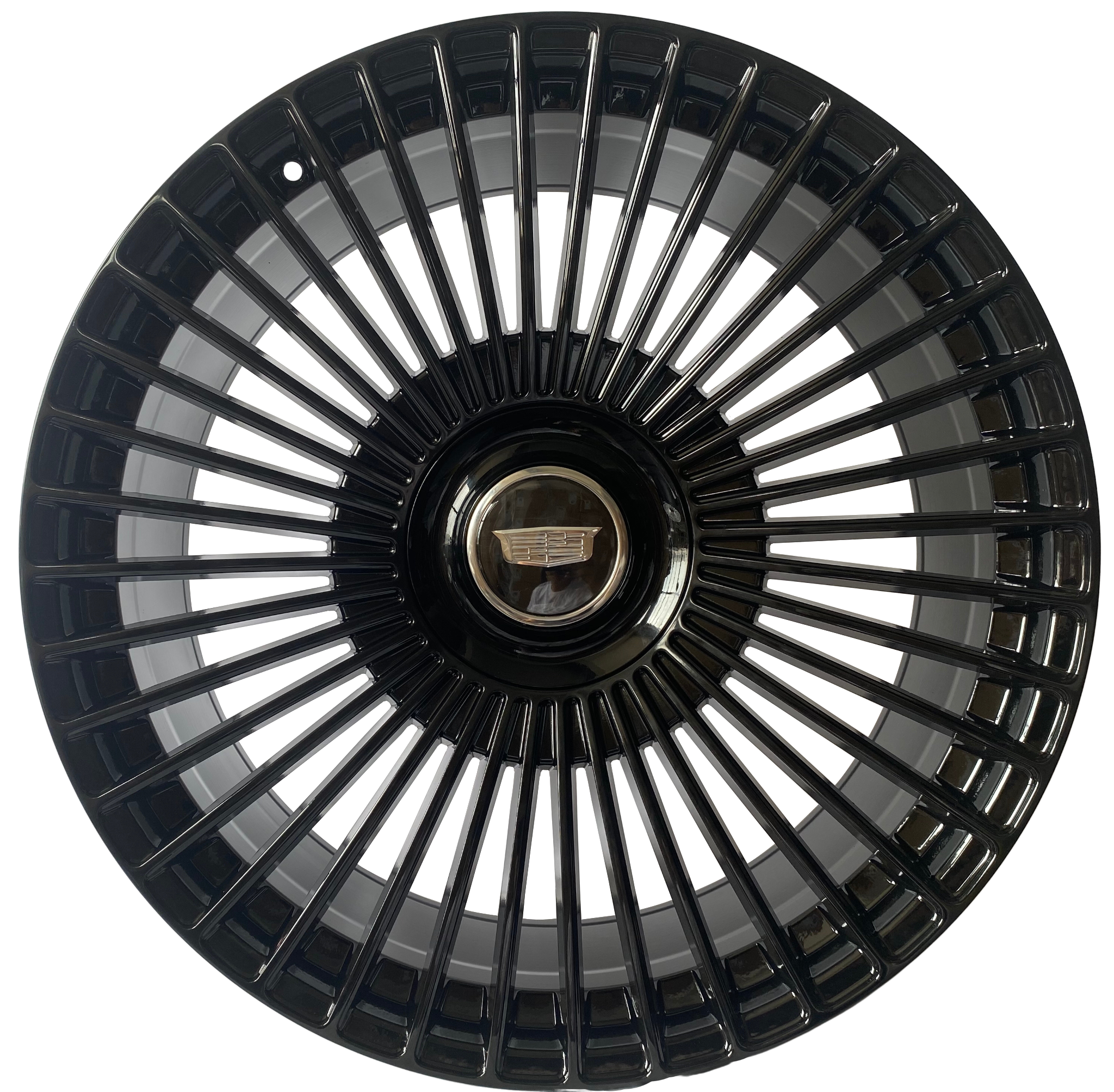
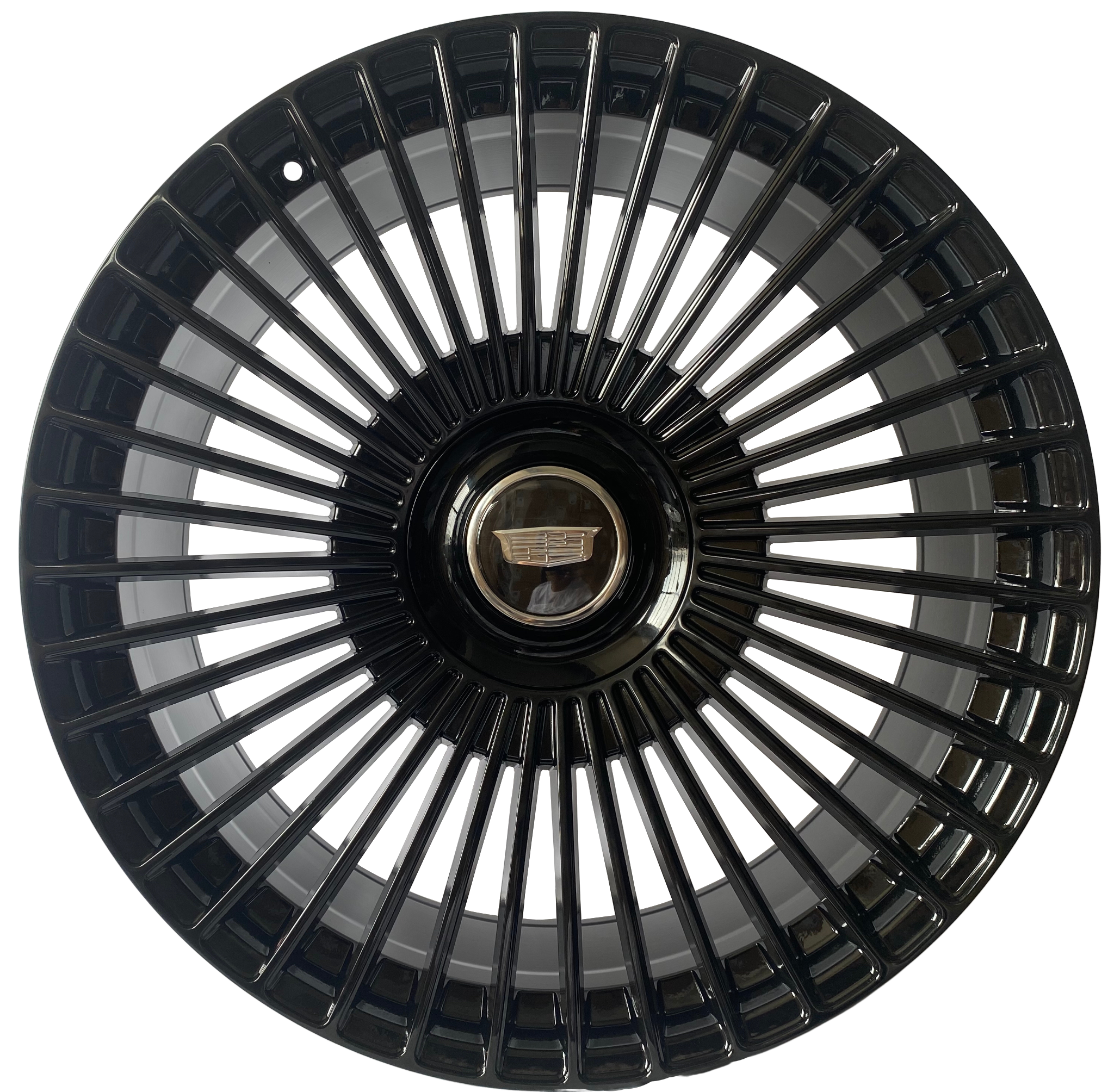


Your 6,000-pound luxury SUV is a masterpiece of modern engineering. It deserves a foundation that matches its massive Gross Vehicle Weight Rating. Most drivers don't realize that standard wheels often struggle under the immense lateral forces of a Cadillac Escalade-V or a Rolls Royce Cullinan. The strength of forged wheels for heavy SUVs is no longer an optional upgrade. It's a structural necessity for maintaining safety at high speeds. You shouldn't have to choose between a striking aesthetic and the peace of mind that your wheels can handle a three-ton load.
We understand the frustration of deciphering complex load ratings and the fear of ruining a $200,000 factory ride. You want exclusivity. You refuse to compromise on structural integrity. This guide will show you how custom-engineered forged wheels transform vehicle stability through superior grain structure and reduced unsprung weight. We'll examine the 2026 standards for SAE J2530 compliance. Discover why 6061-T6 aerospace-grade aluminum is the only material that meets our uncompromising criteria for the world's most prestigious heavy vehicles.
Key Takeaways
- Learn why dynamic impact force is the true test of integrity for 6,000lb luxury vehicles. Static load ratings alone don't guarantee safety during a high-speed event.
- Understand the molecular science behind 6061-T6 aluminum. The strength of forged wheels for heavy SUVs comes from realigning grain structures under 10,000 tons of pressure.
- See why cast wheels fail catastrophically while forged alternatives offer the ductility to bend instead of shattering. This distinction is vital for maintaining control during sudden impacts.
- Discover how to calculate your vehicle's specific requirements. Your wheels should exceed the rear axle load rating found on your door jamb by at least 20 percent.
- Explore why off-the-shelf options often fall short. Custom-engineered fitments for models like the Cadillac Escalade ensure your factory ride quality remains flawless.
The Physics of 6,000 lbs: Why Heavy SUVs Demand More from Wheels
Heavy luxury SUVs represent a pinnacle of automotive achievement. However, their physical presence introduces a dangerous paradox. High mass combined with a high center of gravity creates immense lateral force during high-speed cornering. This isn't a minor concern; it's a structural reality. The strength of forged wheels for heavy SUVs becomes the literal pivot point between stability and structural compromise. In 2026, as SUVs become more powerful and heavier, passenger safety depends on components that exceed factory minimums. Standard wheels often fail the "Weight Test" because they're designed for average conditions, not the extreme physics of a three-ton masterpiece.
Understanding GVWR and Static vs. Dynamic Loads
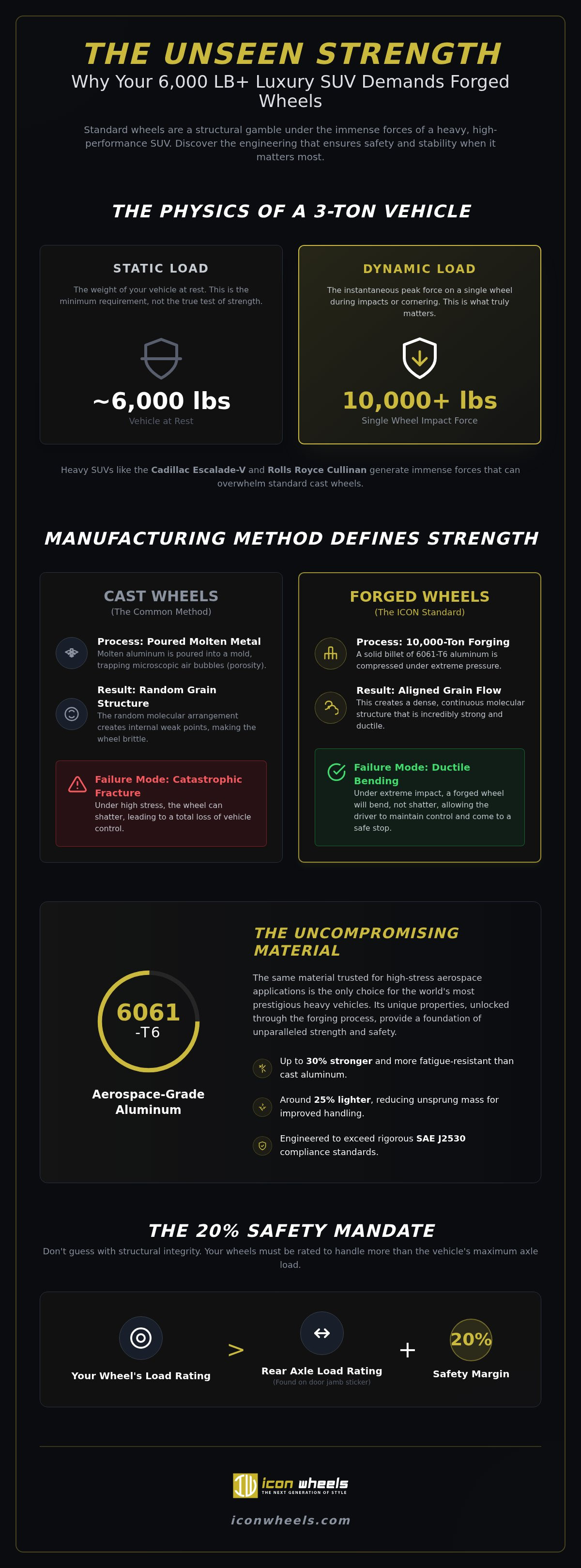
GVWR (Gross Vehicle Weight Rating) is the maximum operating weight of your vehicle, including passengers and cargo. For a 2026 Rolls Royce Cullinan or a Cadillac Escalade-V, this figure is substantial. Most aftermarket options focus on static load, which is simply the weight of the vehicle at rest. This is a critical oversight. When your 6,000lb SUV strikes a pothole or navigates a sharp turn, the physics shift instantly. A single wheel can momentarily face over 10,000lbs of force. Dynamic load is the instantaneous peak force exerted on a wheel during motion, impacts, or rapid weight transfers. If your wheels aren't engineered for these spikes, you're driving on a structural gamble that compromises everyone inside.
The Limitations of OEM Cast Wheels on Heavy SUVs
Manufacturers often prioritize cost-efficiency in Alloy wheel manufacturing to meet mass production targets. This leads to the widespread use of cast aluminum. While visually appealing, cast wheels are created by pouring molten metal into a mold. This process inherently creates "porosity," which is the presence of microscopic air bubbles trapped within the metal. These bubbles act as internal stress concentrators. Under the massive torque of an Escalade-V, these weak points can lead to hairline fractures or catastrophic failure.
The strength of forged wheels for heavy SUVs eliminates this risk entirely. Forging uses 10,000 tons of pressure to compress the metal, creating a dense, grain-aligned structure that cast wheels cannot replicate. Standard rims struggle with the shear force generated by high-output engines moving massive frames. They're built for the showroom, not for the rigorous demands of your lifestyle. When you demand performance from a heavy vehicle, cast wheels are the weakest link in your safety chain.
Engineering Integrity: The Molecular Science of 6061-T6 Forging
The structural performance of a three-ton vehicle depends entirely on the metallurgical integrity of its wheels. In 2026, 6061-T6 aluminum remains the undisputed aerospace standard for high-stress applications. This material is not merely chosen for its lightweight properties; it is selected for its response to extreme pressure. By subjecting a solid billet of this alloy to 10,000 tons of force, we fundamentally alter its molecular structure. This process eliminates the internal voids and microscopic air bubbles that plague mass-produced alternatives. The strength of forged wheels for heavy SUVs is a direct result of this intense compression, ensuring the metal can withstand the relentless torque of modern V8 and electric powertrains.
Molecular Grain Flow: The Secret to Unmatched Strength
Visualizing the difference between manufacturing methods is essential for understanding safety. A cast wheel is "poured" metal; its molecules are arranged randomly, like a bowl of sand. In contrast, a forged wheel is "compressed" metal. This 10,000-ton pressure creates a continuous, directional grain flow that follows the actual shape of the wheel. This structure acts like a high-strength cable. It resists fractures because there are no "loose" molecules for a crack to exploit. For wheels exceeding 22 inches, this molecular continuity is vital. Larger diameters create longer lever arms for stress to act upon. Without directional grain flow, the outer rim becomes a liability under heavy impact. If you are looking to upgrade, our custom built forged wheels utilize this exact engineering to ensure your vehicle remains composed under pressure.
Aerospace Grade 6061-T6: From Jets to the Cullinan
The chemical composition of 6061-T6, involving magnesium and silicon, provides a unique balance of corrosion resistance and high tensile strength. This alloy is further refined through T6 heat treatment, a process of solution heat treating and artificial aging. This maximizes the properties of 6061-T6 aluminum, significantly increasing its yield strength compared to standard 6063 or cast alloys. Yield strength for a Rolls Royce Cullinan wheel represents the specific point where the aluminum can no longer return to its original shape after being stressed by the vehicle's massive dynamic load. While standard alloy wheels might have a yield strength of 20,000 psi, a forged 6061-T6 component often exceeds 35,000 psi. This 75 percent increase in the strength of forged wheels for heavy SUVs provides the safety margin required when navigating high-speed highways in a 6,000lb luxury heavyweight.
Forged vs. Cast Wheels: Analyzing Failure Points Under Extreme Load
The choice between forged and cast wheels is a decision between controlled deformation and catastrophic failure. When a 6,000lb SUV encounters a severe dynamic impact, the wheel material dictates the outcome. Cast wheels are inherently brittle due to their crystalline structure. Under extreme stress, they reach their fracture point and shatter. This is a catastrophic failure mode. The strength of forged wheels for heavy SUVs lies in their ductility. Instead of cracking, a forged wheel is designed to bend. This absorbs energy and maintains the tire's seal, allowing the driver to retain steering control. Safety in 2026 isn't just about preventing damage. It's about managing failure in a way that protects passengers.
Failure Modes: Cracking vs. Bending
A bend is a safe failure. It indicates that the material has reached its yield point but has remained cohesive. Forged wheels effectively act as a secondary suspension component during extreme impacts. They deform slightly to dissipate force that would otherwise shatter a cast rim. This distinction is critical at highway speeds. A cracked cast wheel leads to immediate tire deflation and potential loss of vehicle control. Adhering to SAE J2530 performance standards ensures that wheels are tested for these exact scenarios. Fatigue life also plays a major role. Forged aluminum can withstand millions of additional stress cycles compared to cast alternatives. This makes them the only viable choice for high-mileage luxury heavyweights.
Rigidity and the Vibration-Free Luxury Experience
Structural integrity directly impacts your daily driving comfort. Cast wheels often suffer from microscopic flex under the weight of a Cadillac or Rolls Royce. This flex manifests as subtle, high-frequency vibrations in the steering column. It erodes the "Magic Carpet Ride" experience. Forged wheels offer superior rigidity. This stiffness ensures the wheel remains perfectly round even under heavy cornering loads. It eliminates micro-vibrations and preserves the precision of your vehicle's factory suspension tuning. If you drive a high-performance sedan or SUV, understanding these nuances is essential. You can learn more in our The Definitive Guide to Wheels For Mercedes-Benz. Choosing forged engineering isn't just a safety requirement. It's the only way to maintain the silent, vibration-free cabin you expect from an elite vehicle.
Load Ratings and GVWR: How to Spec Wheels for Your Specific SUV
Selecting the right wheel for a high-mass vehicle requires more than an eye for design. It demands a rigorous understanding of your vehicle's Gross Vehicle Weight Rating (GVWR) and Gross Axle Weight Rating (GAWR). You'll find these critical figures on the door jamb sticker of your driver-side door. For a heavy SUV like the Cadillac Escalade or Rolls Royce Cullinan, the rear axle typically carries the highest load. The strength of forged wheels for heavy SUVs is measured by their ability to support these ratings under dynamic stress. We recommend a "Safety Factor" that exceeds your minimum GAWR by at least 20 percent. This buffer accounts for unexpected impacts and aggressive maneuvers that a standard wheel might not survive.
Calculating the Minimum Safe Load Rating
To determine your requirement, use this simple formula: divide your Rear Axle GAWR by two and add a 20 percent safety buffer. If your rear axle rating is 4,200 lbs, each wheel must handle at least 2,100 lbs plus a 420 lb buffer, totaling 2,520 lbs. Most off-the-shelf wheels are mass-produced for lighter vehicles. They often ignore these specific SUV calculations. They prioritize universal fitment over structural load capacity. Our 22 Inch Range Rover Wheels: Forged Performance are engineered from the ground up to exceed these ratings. If you're moving to 24-inch diameters, the load rating must be even higher. Larger wheels create a longer lever arm. This increases the stress on the hub and spokes during every rotation.
Unsprung Weight: Performance Benefits Beyond Strength
Structural safety is only half the story. The strength of forged wheels for heavy SUVs allows for thinner, lighter spoke designs without sacrificing integrity. Shedding 10 lbs of unsprung weight per corner significantly improves your suspension's ability to track the road. This reduction translates directly to shorter braking distances for 6,000lb vehicles. It also prolongs the life of your SUV's complex air suspension system by reducing the mass it must manage. Hub-centric engineering is equally vital. It ensures the wheel's weight is supported by the hub rather than the lug bolts. This precision fitment eliminates vibration and ensures absolute stability at high speeds. If you value both safety and performance, explore our custom built forged wheels designed specifically for your vehicle's weight profile.
The ICON Standard: Custom-Engineered Forged Wheels for Elite Heavyweights
Engineering excellence is not a universal metric. At ICON WHEELS, we reject the "one-size-fits-all" approach that defines the mass-market wheel industry. The strength of forged wheels for heavy SUVs must be calculated based on the specific weight distribution and torque output of the individual vehicle. We treat every project as a bespoke commission. Our vehicle-specific engineering philosophy ensures that every spoke, barrel, and hub mounting surface is optimized for your SUV's unique profile. We don't just provide wheels. We provide a structural upgrade that enhances the safety and prestige of your vehicle.
Choosing the right architecture is the first step in our process. Monoblock designs offer the ultimate in rigidity and lightweight performance. They are carved from a single solid billet of aluminum. This makes them the preferred choice for those seeking maximum performance. Multi-piece wheels allow for deeper lips and complex, multi-tone finishes. Both architectures are built to our uncompromising standards. You get personalization without compromise. Every offset is custom-tailored to sit flush with your fenders. This creates a commanding stance while maintaining perfect suspension geometry. The ICON guarantee is simple. Our wheels are designed to outperform factory originals in every measurable category.
Precision Fitment for the Rolls Royce Cullinan and Ghost
The Rolls Royce Cullinan presents a unique engineering challenge. Its massive static weight requires a wheel that can resist deformation over long periods of rest. We utilize monoblock rigidity to ensure the wheel remains perfectly round. This prevents the flat-spotting issues common with cast alternatives. For the Ghost, we match the timeless aesthetic while doubling the structural integrity. Our wheels manage the dynamic weight transfers of the Ghost's active suspension with ease. You can explore the technical differences in our guide on Rolls Royce OEM Wheels vs. Custom Forged. We elevate the driving experience without disrupting the legendary silence of the cabin.
Commanding the Road with Forged Cadillac Escalade Rims
Managing the Cadillac Escalade-V requires managing 682 horsepower and 6,000 lbs of mass. This combination generates incredible stress on the wheel hub during rapid acceleration. The strength of forged wheels for heavy SUVs is what allows our 24-inch options to be safer and more durable than factory 22-inch cast rims. We engineer our Escalade fitments to handle the high-torque output of the supercharged V8. This ensures that every launch is stable and every corner is precise. Don't settle for factory limitations. Design your custom forged wheels for Cadillac Escalade and experience the peak of automotive safety and style.
Secure Your Stature: The Future of SUV Structural Safety
Your 6,000lb luxury SUV is a feat of modern engineering that demands equally sophisticated support. We've explored how the strength of forged wheels for heavy SUVs provides the necessary ductility to handle dynamic impacts that would shatter standard cast rims. By utilizing aerospace-grade 6061-T6 aluminum and precision fitment tailored to your vehicle's specific load ratings, you ensure that performance never compromises safety. The molecular integrity of a forged billet is your best defense against the extreme forces of high-speed travel.
Whether you command a Rolls Royce, Mercedes, or Cadillac, your wheels should be as exclusive and robust as the vehicle itself. Don't settle for off-the-shelf compromises that ignore your SUV's GVWR. It's time to elevate your driving experience with components designed to outperform factory standards. Build your custom-engineered forged wheels today and enjoy absolute peace of mind on every journey. Your vehicle represents your success. Its foundation should reflect your commitment to excellence and uncompromising safety.
Frequently Asked Questions
Is the strength of forged wheels really necessary for daily driving?
It's an absolute necessity. Potholes and emergency maneuvers create dynamic loads that far exceed your vehicle's static weight. Standard cast wheels often fail under these sudden peaks. The strength of forged wheels for heavy SUVs ensures that your rims don't shatter during a routine commute. It's about protecting your investment and your passengers. You wouldn't compromise on brakes; don't compromise on the components that connect you to the road.
Can forged wheels handle the weight of a fully loaded Rolls Royce Cullinan?
They're specifically engineered for this purpose. A fully loaded Cullinan can approach 7,000 lbs. Standard aftermarket wheels aren't built for this mass. Our forged options utilize aerospace-grade 6061-T6 aluminum to handle these extreme requirements. We calculate the exact load rating needed for the Cullinan's rear axle. This gives you a safety margin that off-the-shelf products simply can't match. It's the only way to drive with total confidence.
What happens if a forged wheel hits a deep pothole compared to a cast wheel?
The difference is safety versus catastrophe. A cast wheel is brittle. It will likely crack or shatter upon hitting a deep pothole, causing immediate tire deflation. A forged wheel possesses superior ductility. It's designed to bend rather than break. This allows you to maintain steering control and pull over safely. The strength of forged wheels for heavy SUVs provides a structural buffer that manages failure safely instead of failing catastrophically.
How do I check if an aftermarket wheel is properly load-rated for my SUV?
Check the back of the wheel for an official load rating stamp. You must compare this number to the Gross Axle Weight Rating (GAWR) on your driver-side door jamb. Ensure the wheel's rating exceeds half of your highest axle rating by at least 20 percent. Look for SAE J2530 compliance. This standard ensures the wheel has passed rigorous fatigue and impact testing. If the manufacturer can't provide these specs, the wheel isn't safe.
Are forged wheels repairable if they get damaged?
Do forged wheels improve the resale value of a luxury SUV?
You're paying for a superior manufacturing process and elite materials. Forging requires massive 10,000-ton presses and aerospace-grade 6061-T6 aluminum billets. This process is much more expensive than pouring molten metal into a mold. Each wheel is then precision-machined to your vehicle's exact specifications. You aren't just buying a rim; you're buying a custom-engineered safety component. The cost reflects the rarity, craftsmanship, and absolute peace of mind provided by forged technology.
Will forged wheels change the ride quality of my Range Rover?
It will improve significantly. Forged wheels are lighter than their cast counterparts. This reduction in unsprung weight allows your Range Rover's air suspension to react faster to road imperfections. You'll notice sharper handling and a more composed ride over rough surfaces. The increased rigidity also eliminates the micro-vibrations often felt with cheaper wheels. It's the most effective way to enhance the factory "Magic Carpet Ride" while adding a layer of structural safety.
