
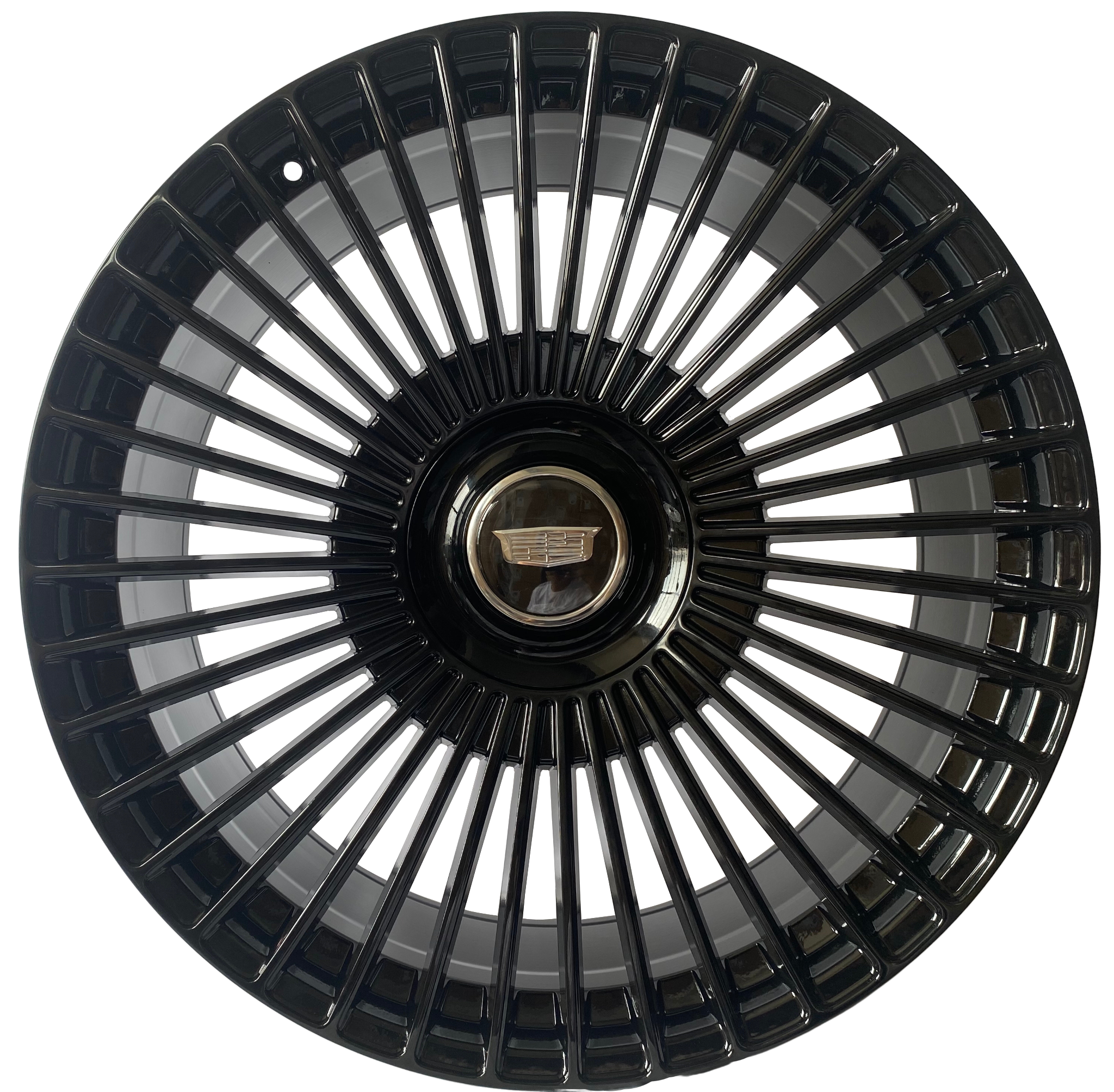
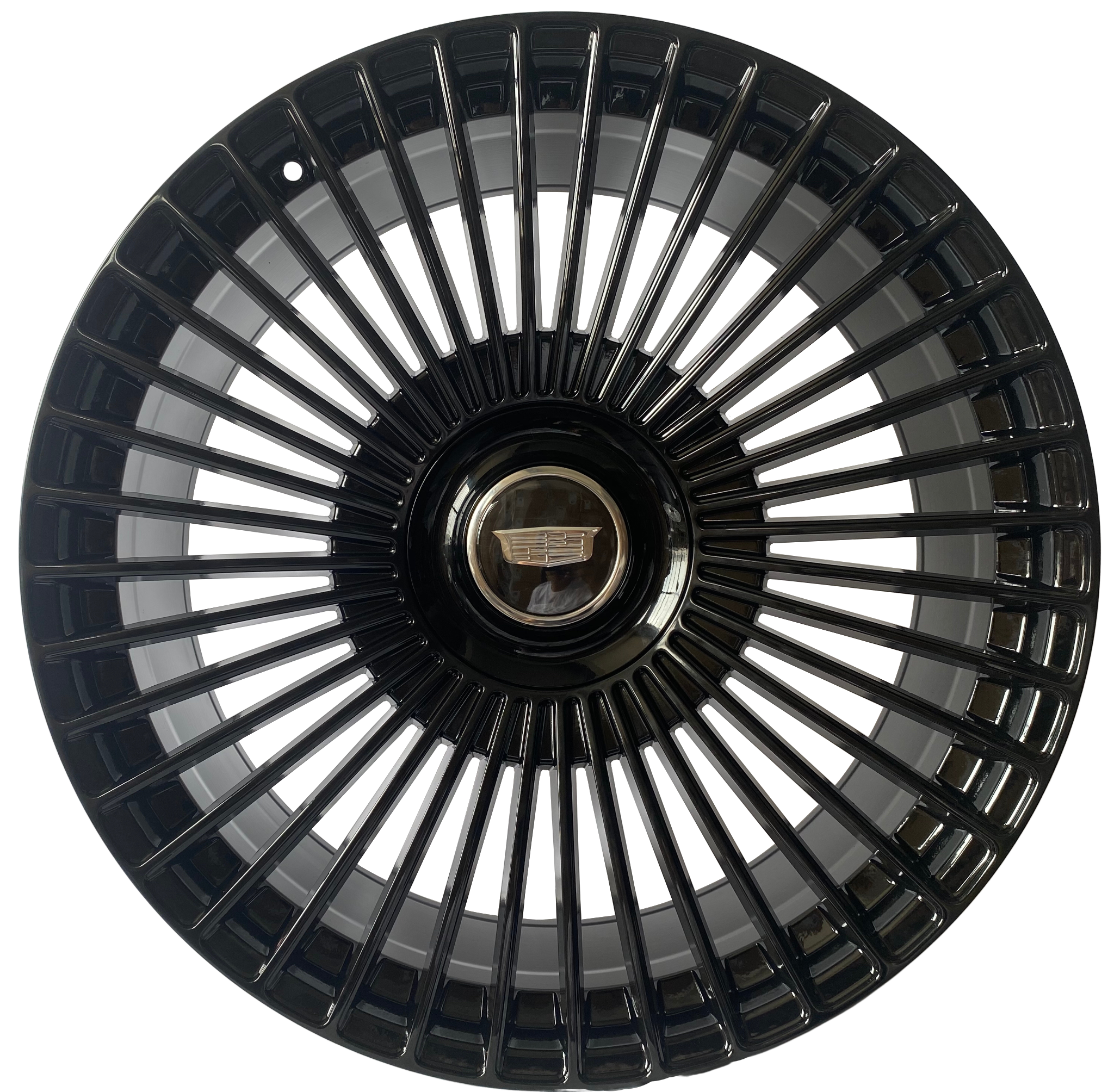


What if the wheels on your three-ton luxury SUV are the weakest link in your vehicle's engineering? You've likely heard that "alloy" is the gold standard for performance, but that term is dangerously vague. Most drivers believe all aluminum wheels offer the same protection. They don't. For a heavy Cadillac Escalade or a Bentley, the manufacturing process matters more than the material itself. We utilize aerospace-grade 6061-T6 aluminum for wheels because it provides the structural integrity that standard cast alloys simply cannot match.
Choosing the wrong manufacturing method isn't just an aesthetic mistake; it's a structural liability. You deserve to know why a forged rim won't crack under the extreme pressure that shatters a generic cast wheel. This comparison breaks down the technical differences so you can select the safest, highest-performing wheels for your Rolls Royce or Porsche. You'll learn to identify the best wheel type for your specific model and understand why a premium forged investment is the only way to justify your vehicle's true potential.
Key Takeaways
- Master the technical hierarchy of cast, flow-formed, and forged manufacturing to ensure your wheels match your vehicle's elite engineering.
- Discover why aerospace-grade 6061-T6 aluminum for wheels is the essential material for maintaining structural integrity in heavy luxury SUVs and high-performance sedans.
- Understand the high-stakes safety difference: forged rims are engineered to bend under extreme stress, whereas standard cast alloys are prone to catastrophic cracking.
- Evaluate how reducing unsprung mass through forged construction directly improves the handling and ride quality of models like the Bentley or Mercedes S-Class.
- Learn how to justify the investment in custom-built forged solutions that offer precision fitment tailored to your vehicle's specific hub and offset requirements.
What Are Alloy Wheels? Defining the Luxury Standard in 2026
In the world of high-end automotive engineering, steel wheels are a relic of the past. They're heavy, visually uninspiring, and functionally limited. Modern luxury vehicles demand more. An Alloy Wheel is a sophisticated blend of aluminum or magnesium with other trace elements. This combination creates a material that outperforms raw metals in every metric that matters to a discerning driver. By 2026, the global market for these components has surpassed $3.38 billion because they're essential for modern performance standards.
Why choose an alloy over traditional materials? It's about three critical factors: weight reduction, aesthetic flexibility, and heat dissipation. Lighter wheels reduce unsprung mass. This means your suspension reacts faster. Your steering feels sharper. For a heavy SUV like the Cadillac Escalade or a Range Rover, this isn't just a luxury; it's a necessity for maintaining ride quality. Alloys also pull heat away from your brake system more efficiently than steel ever could. This prevents brake fade during spirited driving or when navigating steep descents. The industry has moved beyond basic mixtures. Today, 6061-T6 aluminum for wheels is the definitive benchmark for custom forged rims. It represents the perfect intersection of aerospace technology and automotive art.
The Anatomy of an Alloy Wheel
Every wheel is a complex assembly of specific zones designed to handle immense stress. The barrel provides the structural drum, while the lip defines the outer edge and stance. The spokes transfer the load from the center bore to the rim, acting as the primary aesthetic and structural bridge. In ultra-high-end racing applications, magnesium is often added to the mix to further reduce weight. The T6 heat treatment is a specialized metallurgical process where the alloy is solution heat-treated and then artificially aged to achieve its peak strength and durability. This ensures the wheel can withstand the weight of a Mercedes S-Class without compromising integrity.
Why Material Choice is Only Half the Story
Don't confuse the material with the method. "Alloy" describes what the wheel is made of, not how it was built. You can have a cast alloy wheel that's brittle and heavy, or a forged alloy wheel that's incredibly strong. While exotic carbon fiber alternatives exist for supercars, they often lack the daily-driver durability and repairability of premium aluminum. For a Rolls Royce Ghost or a Bentley, the manufacturing process determines whether that material becomes a performance masterpiece or a structural liability. Understanding this distinction is the first step toward choosing wheels that actually enhance your vehicle's capabilities.
The Manufacturing Spectrum: Cast vs. Flow Formed vs. Forged
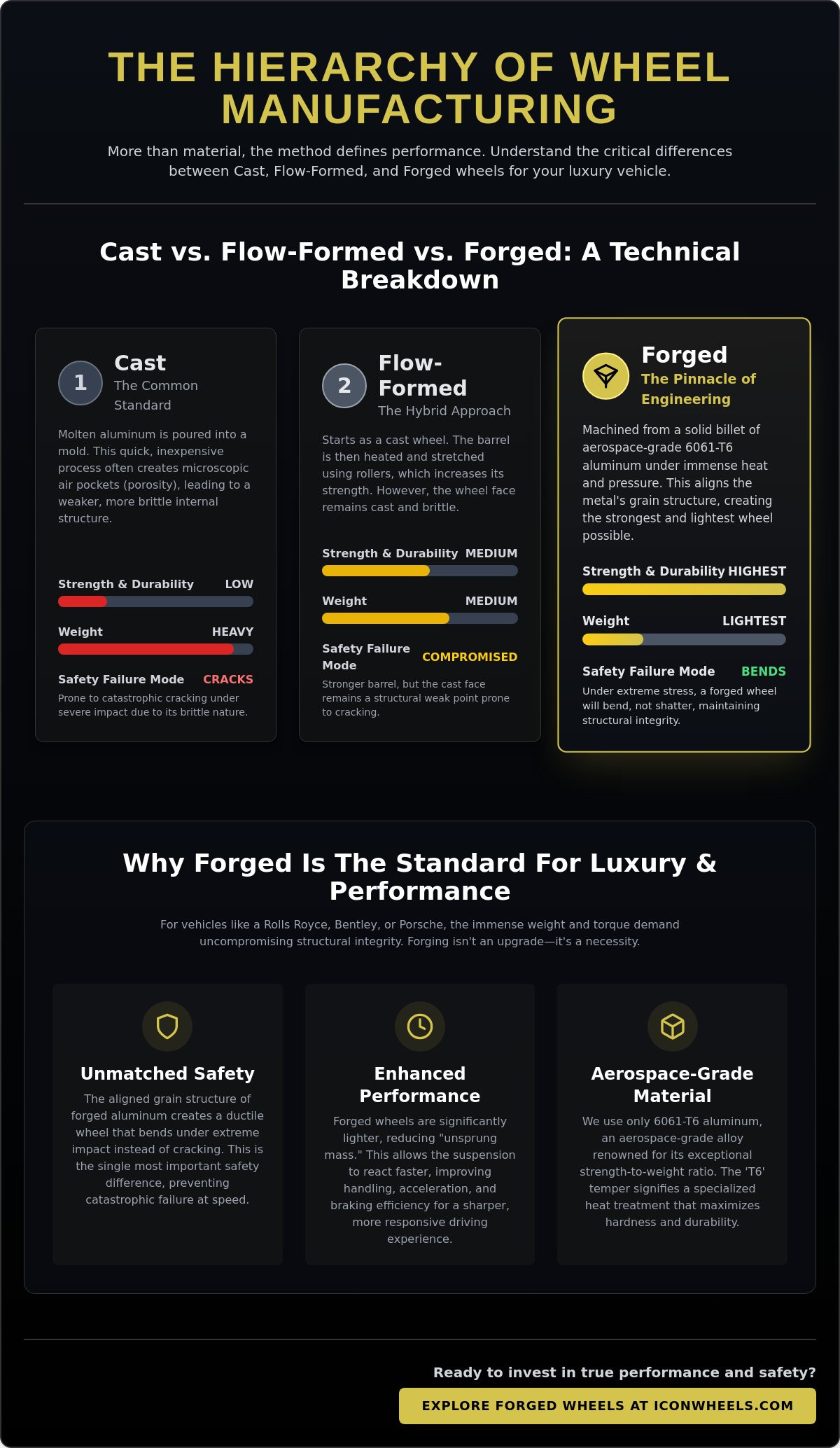
Manufacturing method determines whether your wheel is a performance asset or a structural liability. It's the difference between a wheel that survives a surprise pothole and one that shatters. While the material defines the potential, the production process defines the reality. For luxury car owners, understanding the price-to-performance ratio of these methods is essential. You aren't just buying a look; you're investing in the engineering that supports your vehicle's weight and power.
Casting: The Entry-Level Standard
Casting is the most common manufacturing method because it's fast and inexpensive. Molten aluminum is poured into a mold using gravity or low pressure. Once it cools, it takes the shape of the wheel. However, this process is inherently flawed for high-performance applications. As the metal cools, microscopic air pockets called porosity form within the structure. This makes cast wheels brittle. For a heavy Rolls Royce Ghost or a high-torque Lamborghini, cast alloys are often unsuitable. They lack the density required to handle extreme stress. If a cast wheel fails, it doesn't bend; it cracks.
Flow forming serves as a middle ground. It starts as a cast "blank" that is then placed on a machine that spins and heats the wheel. Hydraulic rollers stretch the barrel, increasing its tensile strength. This makes the barrel stronger and lighter than a standard cast wheel. But there's a catch. The center face of the wheel remains cast. It still possesses the same brittle grain structure as an entry-level rim. It's an improvement, but it isn't the ultimate solution for elite builds.
Forging: The Pinnacle of Wheel Engineering
Forging stands alone at the top of the hierarchy. We don't pour liquid metal into a mold. Instead, we take a solid billet of aerospace-grade alloy and subject it to over 10,000 tons of intense pressure. This immense force crushes the metal into shape, eliminating porosity and aligning the internal grain structure. This level of precision is why we adhere to the SAE International standard for 6061-T6 aluminum. The resulting grain flow is continuous, following the contours of the wheel's design for maximum integrity.
The result is a wheel that is significantly thinner, lighter, and stronger than any other type. It bends where cast wheels shatter, providing a critical safety margin. For a detailed breakdown of how this applies to high-performance SUVs, read our forged wheels for Porsche Cayenne engineering guide. Utilizing 6061-T6 aluminum for wheels ensures that every spoke can handle the massive load capacity of a Cadillac Escalade or a Mercedes S-Class. If you demand perfection, you should consider Custom Built Forged Wheels for your next upgrade. This manufacturing method isn't just about status. It's about the uncompromising pursuit of safety and performance.
Forged vs. Cast: The High-Stakes Comparison for Luxury Cars
Physics doesn't care about your vehicle's badge. It cares about load, force, and structural limits. For a 5,000-pound luxury SUV, the difference between cast and forged manufacturing is the difference between a safe journey and a catastrophic failure. Cast wheels are produced by pouring liquid metal into a mold, a process that inherently leaves microscopic air pockets. When a cast wheel hits a deep pothole at highway speeds, it doesn't just bend. It shatters. Forged wheels react differently. Because the metal is crushed into high density, it possesses the ductility to bend under extreme stress, often allowing you to maintain control and reach safety.
The aesthetic advantage is equally undeniable. Because forged metal is significantly stronger than cast aluminum, engineers can use less of it. This allows for thinner, more intricate spoke designs that would be physically impossible to achieve with a casting. A cast wheel requires thick, chunky spokes to maintain its rating, which often looks clunky on a refined Bentley or Lamborghini. Forged construction delivers a sharp, "razor-edge" finish that complements the lines of a modern exotic. It's a lifetime investment. While cast wheels degrade and become brittle over time, a forged rim remains a permanent performance asset for the life of your vehicle.
Structural Integrity and Load Ratings
Load rating is the most critical metric for any heavy-duty luxury build. Vehicles like the Rolls Royce Cullinan or the Cadillac Escalade exert massive downward force on every wheel. We utilize 6061-T6 aluminum for wheels because it offers the highest yield strength in its class. Forging allows us to achieve superior load ratings with less material, reducing the physical bulk of the wheel without sacrificing safety. You can verify the technical benchmarks of this material by reviewing the 6061-T6 aluminum properties which highlight its incredible resistance to fatigue and stress corrosion. In high-speed impacts, this structural density ensures the wheel remains a single, cohesive unit.
Performance Dynamics: Unsprung Weight and Inertia
Weight isn't just about the number on a scale. It's about where that weight is located. Unsprung weight refers to the components not supported by your car's springs, specifically your wheels and tires. Reducing this mass has a massive impact on suspension response. When you switch to lighter forged alloys, your suspension reacts faster to road imperfections. This improves ride quality in a Mercedes S-Class and sharpens the turn-in response of a Porsche. Lighter wheels also have less rotational inertia, meaning your brakes don't have to work as hard to stop them. For specific performance data on how this transforms a luxury sedan, consult our Definitive Guide to Wheels For Mercedes-Benz. Every pound saved at the wheel hub feels like ten pounds removed from the chassis.
Selecting the Right Alloy for Your Vehicle Class
Engineering a wheel isn't a one-size-fits-all process. A Mercedes S-Class follows a different set of physical laws than a Lamborghini. You must match the manufacturing method to your vehicle's specific mission. For elite sedans, the goal is effortless comfort and vibration damping. For heavy SUVs, it's about surviving massive vertical loads. For exotics, the challenge is managing extreme heat and rotational torque. Choosing the wrong wheel class doesn't just hurt performance. It compromises the very soul of your vehicle's handling.
The Heavyweight Challenge: Cullinan and Escalade
Ultra-luxury SUVs like the Rolls Royce Cullinan and Cadillac Escalade are engineering marvels that often exceed 6,000 pounds. This mass places incredible stress on the wheel's center bore and spokes, especially during cornering. Large 24-inch cast wheels are a genuine liability on these platforms. They're heavy, which ruins the ride quality, and brittle, which risks failure under load. We utilize 6061-T6 aluminum for wheels to provide the necessary structural density without the dangerous weight of cast alternatives. Forged rims offer a load-bearing safety margin that generic alloys simply can't reach. If you're looking to upgrade a Land Rover, consult our Guide to 22 Inch Range Rover Wheels to understand how forged performance transforms a heavy chassis.
Exotic Torque: Handling High Horsepower
High-performance engines generate massive torque that translates into shear forces at the wheel center. This force literally tries to twist the spokes away from the hub. Forged monoblock construction is the only logical choice for track-capable exotics like Porsche or Lamborghini. Because the wheel is carved from a single solid billet of 6061-T6 aluminum for wheels, there are no welds or bolts to fail. This design maximizes stiffness and ensures that every bit of horsepower reaches the pavement without wheel flex. You can see this engineering in action in our guide to Custom Wheels for Cadillac CT5-V, where we detail how to handle the specific torque demands of V-Series models.
Always verify your specifications before purchasing. Check the wheel's load rating against your vehicle's Gross Axle Weight Rating (GAWR). Ensure the offset is precision-engineered for your specific hub and brake clearance. "Universal" fitments are for economy cars, not for your Bentley or Rolls Royce. If you demand a wheel that matches the elite status of your vehicle, explore our Custom Built Forged Wheels today. Don't settle for a compromise when you can have a precision-forged masterpiece.
ICON WHEELS: The 2026 Forged Standard
ICON WHEELS doesn't follow industry trends. We dictate them. Our commitment to excellence means we exclusively offer custom-built forged solutions. Standard cast wheels are a compromise we refuse to make for our clients. Every wheel we produce is a masterclass in structural integrity and modern elegance. We understand that your vehicle is an extension of your status and personal brand. It deserves a wheel that is engineered for peak performance, not just manufactured for mass consumption. In a global market projected to reach $5.77 billion by 2035, we remain the elite choice for those who demand the best.
Precision fitment is our baseline requirement. We don't believe in spacers, universal hub rings, or "close enough" measurements. Each set of rims is engineered for the specific hub, offset, and brake clearance of your luxury model. Whether you drive a Lamborghini or a Bentley, the fitment is absolute. This level of detail ensures that your vehicle's factory suspension geometry remains perfect. It's the only way to maintain the ride quality and handling characteristics you expect from a flagship vehicle. We eliminate the guesswork so you can focus on the drive.
Our Engineering Philosophy
We utilize aerospace-grade 6061-T6 aluminum for wheels because it's the only material that meets our rigorous standards. This alloy provides a strength-to-weight ratio that allows for the most aggressive, thin-spoke designs without sacrificing safety. Our engineering process is model-specific. We create tailored solutions for the Rolls Royce Ghost, the Bentley Continental, and the Mercedes S-Class. Every spoke is analyzed for load capacity and stress distribution before a single cut is made. We provide national delivery and elite support to ensure your experience is as seamless as the performance of our wheels.
Beyond the Rim: A Comprehensive Luxury Upgrade
A custom wheel defines the presence of your vehicle. It's the most impactful visual change you can make to a high-end build. We offer a customization journey that ranges from sleek, lightweight monoblock designs to intricate multi-piece forged structures. Each design is crafted to match your vehicle's specific design language. A Range Rover requires a different aesthetic energy than a Porsche 911. We ensure the stance is perfect and the presence is undeniable. We use 6061-T6 aluminum for wheels to ensure these designs remain timeless and durable.
Investing in forged quality is a strategic decision. Cheap cast wheels lose value quickly and can even detract from your car's appeal on the secondary market. In contrast, premium forged rims preserve the resale value of your vehicle. They're recognized by collectors and enthusiasts as a mark of a well-maintained, high-performance machine. You're not just buying wheels; you're securing a performance asset. Take the next step in your vehicle's evolution and settle for nothing less than perfection. Explore our custom forged collections for your luxury vehicle and discover the ICON difference.
Elevate Your Vehicle to the Forged Standard
Your luxury vehicle is a masterpiece of engineering. Don't compromise its potential with generic cast alloys that risk cracking under pressure. The manufacturing process determines whether your wheels are a performance asset or a structural liability. We exclusively utilize aerospace-grade 6061-T6 aluminum for wheels to provide the density and ductility required for heavy SUVs and high-torque exotics. This investment preserves your vehicle's resale value and enhances every aspect of its handling dynamics. You've mastered the technical differences between casting and forging. Now, it's time to choose the safest, highest-performing path for your Rolls Royce, Mercedes, or Range Rover.
Our engineering team is ready to craft a solution that fits your specific hub and offset with absolute precision. Stop settling for universal compromises that dilute your car's presence. Elevate your status on the road with a custom design that reflects your unique style and uncompromising standards. Design Your Custom Forged Wheels Today and secure the ultimate luxury performance upgrade for your flagship vehicle. Your pursuit of excellence deserves nothing less than the ICON forged standard.
Frequently Asked Questions
Are all alloy wheels made of the same material?
No, the term alloy simply refers to a mixture of metals. While most wheels use aluminum as a base, the specific grade and trace elements vary significantly. We exclusively use aerospace-grade 6061-T6 aluminum for wheels because it offers a structural density that generic alloys found in mass-produced cast rims can't match. Choosing the right material grade is the first step in ensuring your wheel is a performance asset rather than a liability.
Why are forged alloy wheels so much more expensive than cast ones?
The price reflects the immense energy and specialized machinery required for the forging process. Casting involves pouring liquid metal into a mold, which is fast and inexpensive but leaves microscopic air pockets. Forging uses 10,000 tons of pressure to crush a solid billet into shape, eliminating all internal flaws. You're investing in a denser, safer, and more durable product that requires significantly more engineering hours to produce.
Can I put standard alloy wheels on a Rolls Royce Cullinan or Cadillac Escalade?
You shouldn't, as standard cast alloy wheels often lack the load rating required for 6,000-pound vehicles. Heavy luxury SUVs place extreme vertical stress on wheel spokes, especially during high-speed cornering. A generic cast rim might fit the hub, but it's a structural risk on such a heavy platform. Forged wheels provide the necessary load-bearing safety margin to handle these massive vehicles without the risk of catastrophic cracking.
Do forged wheels actually improve the ride quality of a luxury sedan?
Yes, forged wheels improve ride quality by reducing unsprung weight. Every pound removed from the wheels allows your suspension to react faster to road imperfections. In a Mercedes S-Class or Bentley, this translates to a smoother, more refined cabin experience with less vibration. You'll notice a more composed ride because the springs and dampers don't have to work as hard to control the wheel's movement.
What is the difference between 1-piece (monoblock) and 3-piece forged wheels?
The difference lies in construction and aesthetic flexibility. Monoblock wheels are carved from a single solid billet of 6061-T6 aluminum for wheels, offering the highest level of stiffness and the lowest weight. 3-piece wheels consist of a center face, an inner barrel, and an outer lip bolted together. This modular design allows for extreme widths and deep-dish offsets that are perfectly tailored to your vehicle's specific stance and presence.
How do I know if my current wheels are cast or forged?
Check the back of the spokes for raised lettering or engraved markings. Cast wheels usually have raised text that was part of the mold, along with thicker, chunkier spokes to compensate for the material's lower strength. Forged wheels typically feature sharp, crisp edges and engraved text. If the spokes are exceptionally thin and the wheel feels surprisingly light for its size, it's likely a forged component.
Are magnesium alloy wheels better than aluminum for daily driving?
No, magnesium wheels are generally unsuitable for the rigors of daily road use. While they're lighter than aluminum, magnesium is more brittle and highly susceptible to corrosion from road salt and moisture. Forged aluminum remains the elite standard for luxury flagships because it provides the best balance of extreme strength, weight reduction, and long-term durability in all weather conditions.
Do custom forged wheels affect my vehicle’s factory warranty?
Properly engineered forged wheels don't void your entire vehicle warranty. Law protects consumers by requiring manufacturers to prove that an aftermarket part caused a specific failure before denying a claim. Because we engineer our wheels to match your factory hub specifications and offsets precisely, they maintain the mechanical integrity of your vehicle. You can enjoy a customized look and improved performance without compromising your peace of mind.
